O|Zone™ Initiative
An InfoPort™ Collection of Foundational O|Zone™ Ecosystems for Local Communities
The future isn’t something
we wait for.
It’s something
we build.
Welcome to LAUNCH [OK]™.
Every generation has an opportunity to shape the future it leaves behind.
For more than forty years, we have had the privilege of working alongside extraordinary people, organizations, institutions, businesses, and communities.
Together, we have explored new ideas, developed new technologies, built new enterprises, and helped create frameworks that have connected innovation with implementation across many industries and in many parts of the world.
Those experiences have reinforced a simple belief.
The future is created when people choose to envision it and build it.
Every community possesses unique strengths. Their organizations contribute unique capabilities. Individuals bring ideas, experience, and imagination that can become the foundation of new opportunities.
LAUNCH [OK]™ has been created to help connect those strengths.
It provides a framework for bringing together communities, education, healthcare, agriculture, manufacturing, infrastructure, government, business, finance, technology and now, Digital Transformation.
Together, they create opportunities that can be envisioned, developed, funded, and successfully implemented.
Consider this is an invitation.
An invitation to participate.
To collaborate.
To innovate.
To build relationships that create lasting value for Oklahoma and for future generations.
The content that follows explores a framework evolved through decades of experience, which continues to grow through the contributions of those who choose to build its future.
We believe communities can accomplish far more when people, ideas, capabilities and capital are able to come together and participate within a common framework.
Welcome to LAUNCH [OK]™.
Let’s build.
An InfoPort™ Collection of Foundational O|Zone™ Ecosystems for Local Communities
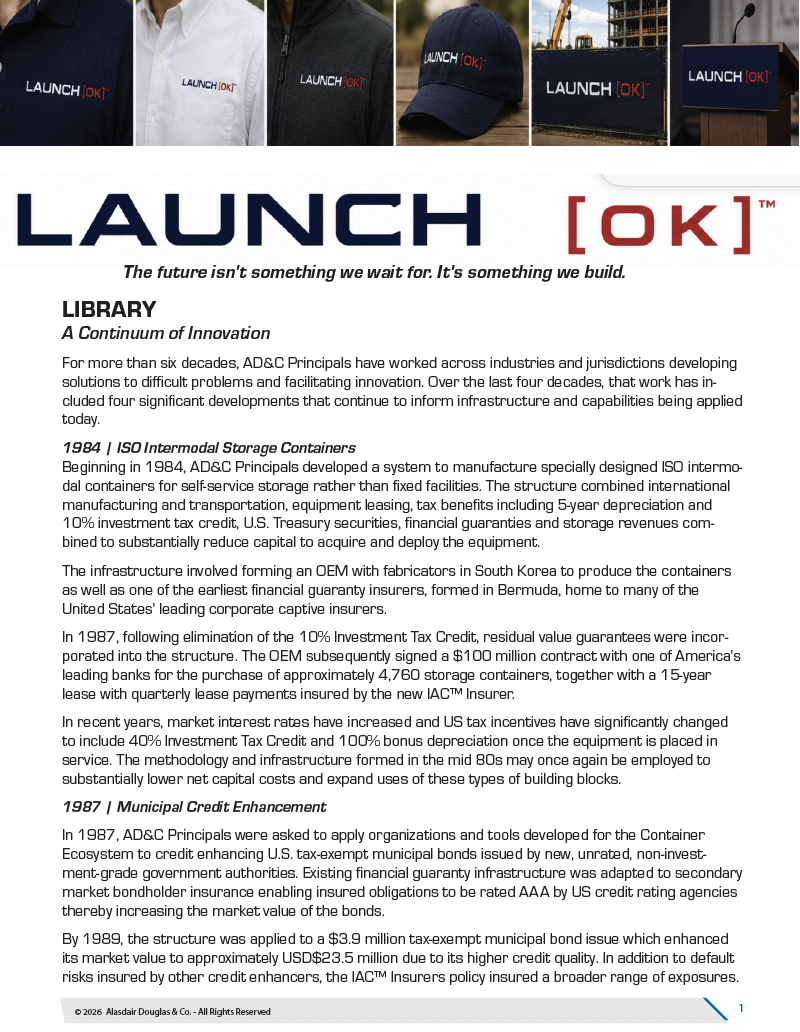
As you scroll down, you’ll find links throughout this site to 20 Site Resources that make up the LAUNCH [OK] Library, as well as several explanatory pdfs.
The Library PDF to the right provides a brief description of each Site Resource, with links that take you directly to the Resource you may want to explore.
Hi, there’s a lot to explore here, so we’ve made it easy to choose where to begin.
If you want LAUNCH [OK]™ Cliff Notes, press "Introduction" below the first image.
The six Cliff Notes provide a short look at different parts of the Resource, with “Library” introducing the broader collection of Resources available throughout Launch [OK]™.
Press any image to move directly to that section of the full LAUNCH [OK]™ Resource.
At the end of each section, a button will bring you back here.
And If you’d rather just keep scrolling, from time to time, I'll point out some areas of interest.
Each O|Zone™ Opportunity Innovation Ecosystem is designed to bring together local community resources, businesses, Government Authorities, Community Banks, technologies, and other participants to identify and develop Opportunities that can strengthen the community and expand economic activity
A county implementation of the O|Zone™ Initiative is intended to bring together local capabilities and relationships that can help catalyze O|Zone™ Opportunities and the Opportunity Innovation Ecosystems that develop around them. As these Opportunities and Ecosystems grow, they may naturally connect with participants, resources, institutions and other Ecosystems well beyond the county—while creating expanding economic, infrastructure and quality-of-life benefits within the county, its Port Authority Opportunity Zone and throughout the state.
By connecting local Opportunities with capital, funding, risk capacity, infrastructure, and broader institutional capabilities, O|Zone™ is designed to help each Opportunity become activity—and that activity creates continuing economic, infrastructure and quality-of-life benefits for communities and the state.
So what does all of that mean?
For me, it’s actually pretty simple. Over the years, we’ve developed and assembled a broad range of capabilities that we think can be useful for local Communities.
Launch [OK]™ is about bringing those capabilities together in Oklahoma and launching the framework, so individual Counties can begin configuring around their own people, resources, needs and Opportunities.
So let me show you some of what we’ve been developing.
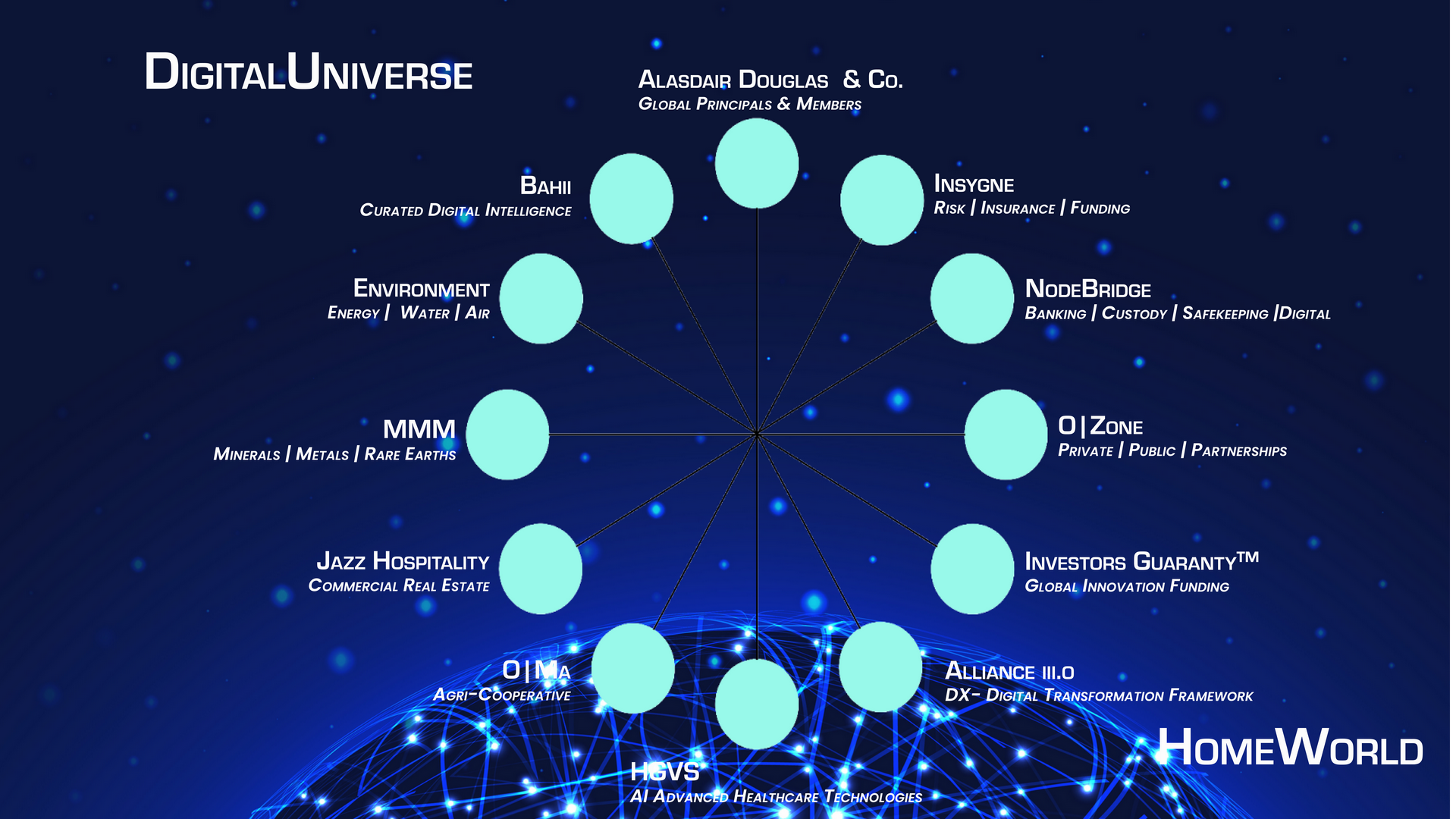
The twelve Initiatives you’re about to see reach into very different areas of Community life and economic activity.
Each has a place in every Community.
What will be different is how they are configured locally and how they come together.
For more than four decades, AD&C Principals and their collaborators have built, financed, acquired and operated companies, technologies and platforms across insurance, banking and capital markets, government finance, healthcare, infrastructure, data and computing, other regulated and non-regulated environments
—including institutional technologies spanning global market data, risk analytics, regulatory systems and distributed computing.
Those efforts have created substantial resource silos within twelve Initiatives—people, regulated and non-regulated organizations, foundations, technologies, intellectual property, financial and contractual structures, operating platforms and institutional relationships. Those silos have been continuously enhanced. As technologies, markets, regulations and opportunities change, new capabilities are developed or added and configured across applicable resource silos to address intractable issues and create new opportunities.
This continuing process allows decades of accumulated and continually expanding capability to be applied in new configurations within communities, companies, governments and combinations of them. Through these Initiatives, local ideas, resources, institutions and participants can connect with broader networks of capital, technology, expertise, infrastructure and opportunity.
Communities are transformed when ideas are connected with people, institutions, infrastructure and long-term capital. That is why LAUNCH [OK] is built upon Opportunity Innovation Ecosystems.
Every vision benefits from a framework.
Ideas inspire change. Frameworks make change possible.
OPPORTUNITIES
What might we build together?
Sometimes an Opportunity begins with an individual, business or organization that sees something that could be done—or done differently. An O|Zone™ Opportunity provides a role-based framework for bringing together participants, facilities, equipment, resources and operating capabilities needed to move an idea toward implementation.
Other Opportunities may be considerably larger: developments, facilities, campuses and infrastructure that engage local businesses, developers, contractors, institutions and other participants—and may themselves create environments in which many individual O|Zone™ Opportunities can emerge.
Underlying these Opportunities is a simple idea: build modularly. Participants, roles, resources and economic interests can be organized as distinct but connected components, just as the facilities, equipment, infrastructure and funding that support an Opportunity can increasingly be assembled in modular ways.
STEWARDSHIP
Applying experience and capabilities...
Stewardship begins with people. LAUNCH [LABS] provides a collaborative environment where individuals, businesses, professionals, institutions and other participants can introduce ideas, experience and capabilities together to explore, configure and help launch new Opportunities.
Around those Opportunities, enduring Steward enterprises can provide specialized capabilities. Project Stewards help shepherd projects from concept through development and implementation and remain engaged as projects evolve. Integration Stewards help bring modular systems together on site and facilitate their continuing maintenance, repair, replacement, reconfiguration and upgrading. Technical Stewards bring together the professional, financial, tax, legal and other capabilities needed to facilitate specialized participants, assets and structures.
Developers may undertake the development of a project, property or infrastructure associated with an Opportunity—bringing together land, facilities, improvements, contractors, financing and other resources required for implementation. Depending upon the Opportunity, a Developer may be an existing participant or a specialized party brought into the configuration.
Together, these Stewardship and Developer capabilities help connect ideas and participants with the professional, physical, financial and other resources required to move Opportunities from possibility into continuing operation.
FUNDING
Engaging individuals, family trusts/offices, businesses, non-profits, governments and institutions...
The modular nature of the framework creates several distinctly different pathways for participation. High-income individuals, family trusts, family offices and others with substantial annual federal, state and local tax obligations may be able to participate through ownership of qualifying equipment and other assets. In appropriately structured circumstances, available federal, state and local tax incentives may materially offset the cost of acquiring qualifying assets—potentially representing as much as 85% of acquisition cost for participants with sufficient qualifying tax capacity. Individuals may also participate through high-quality tax-exempt municipal bonds and ETF units supported by high-quality institutional debt obligations.
Community banks, private lenders and other national and international participants can help finance individual Opportunities and their components. Larger projects and infrastructure may also draw upon tax-exempt municipal obligations issued through qualifying local Government Authorities, together with high-credit-quality obligations and risk structures designed for insurance companies, banks, pension and retirement funds, sovereign wealth funds and other institutional participants in U.S. and international markets.
The objective is not a single source of funding, but a suite of funding tools drawing upon financial structures developed and applied over more than four decades, through which participants can help build and support different components and scales of Opportunity.
The pages that follow explore these pathways in greater depth and introduce additional ways individuals, organizations, enterprises and communities may choose to participate.
Before we go much further, I’d like to tell you a little about us and why we’ve assembled this resource.
For more than four decades, AD&C Principals and our collaborators have worked across a wide range of industries and jurisdictions—developing new ideas and technologies, creating and implementing solutions, and developing new ways for people and organizations to work, collaborate and innovate.
We’ve learned a great deal along the way.
Today, many of those ideas, technologies, capabilities and solutions are being brought together in ways that simply weren’t possible when much of this work began.
We believe some of what we’ve learned and developed may be useful to Communities in Oklahoma and elsewhere, so we’ve brought much of it together here as a resource, organized into three broad bodies of work: Opportunity, Stewardship and Funding.
We’ve made it easy to scan,
so I hope you’ll explore the areas that interest you and particularly the links to expanded information.
As we go, I’ll check in from time to time.
I’ll highlight areas that may be particularly relevant to various readers and point you toward more in-depth resources where you can explore further.
Most importantly, welcome. We’re very pleased you’re here.

Opportunity = something that can be done.
It may be an individual with an idea, a business ready to expand, an institution seeking new capabilities, or a community looking to improve infrastructure and quality of life. Some Opportunities may be small and highly focused; others may involve facilities, campuses, infrastructure and development across a much larger scale.
The O|Zone™ framework is designed to help connect those Opportunities with people, resources, infrastructure and funding—and to provide multiple ways for individuals, businesses, institutions and communities to participate in making them possible.

An O|Zone™ Opportunity brings that idea down to a defined operating unit.
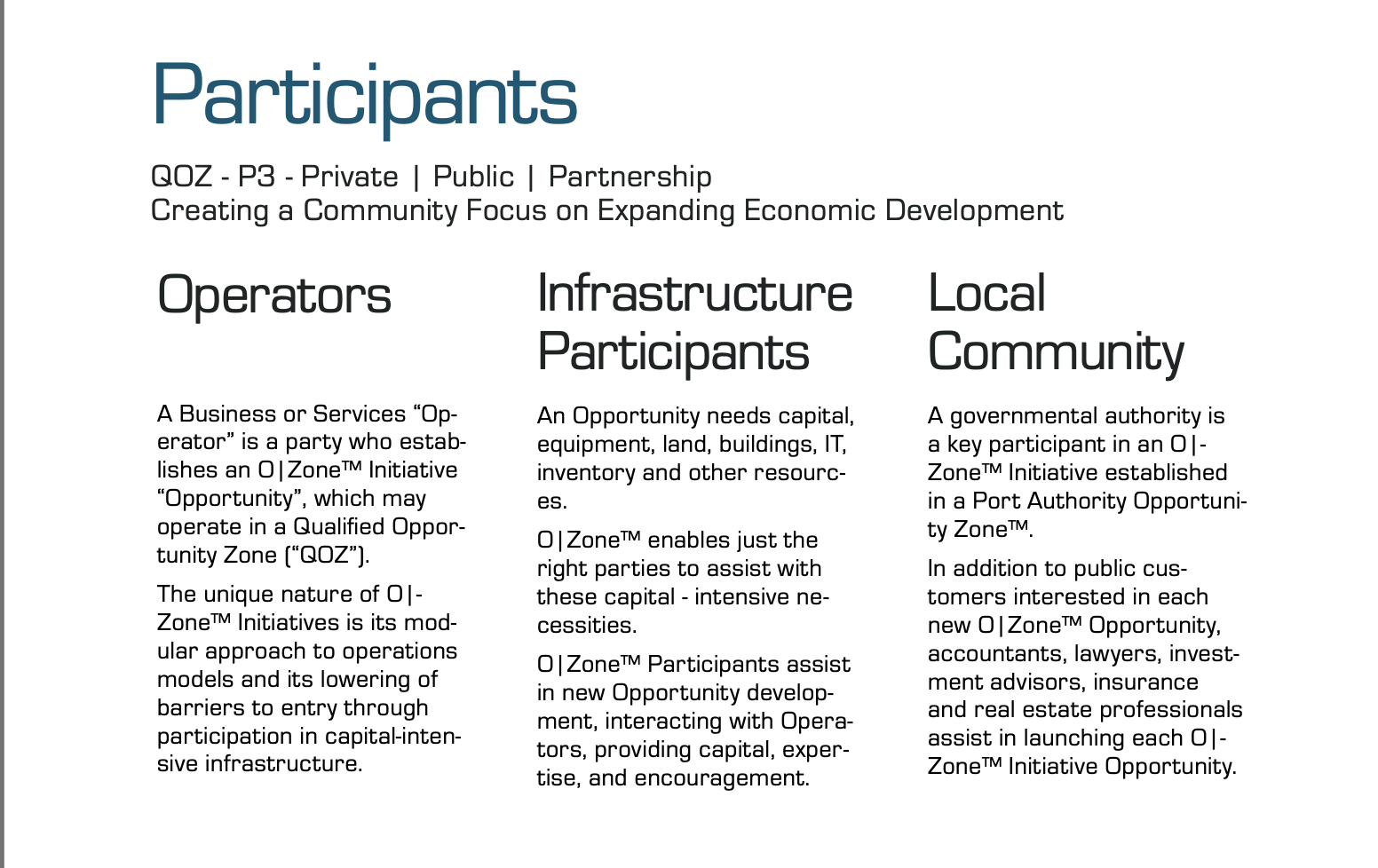
It connects a Business | Services Operator with the land, facilities, equipment, inventory, technologies and other resources needed for the Opportunity to operate. Those components may be provided by different Infrastructure Business Participants, with Government Authorities and local professionals participating where appropriate.
Because the components can be separately organized, owned and brought together around the Operator, an O|Zone™ Opportunity creates multiple points of participation—enabling the person with the idea and the people with the resources to build something together.
One of the things I have learned over the years is that the person with the idea does not always have the capital, facilities, equipment or other resources needed to make it happen. And the person(s) who can provide those resources often brings something equally valuable—experience, relationships and a willingness to mentor the person who is building the Opportunity.
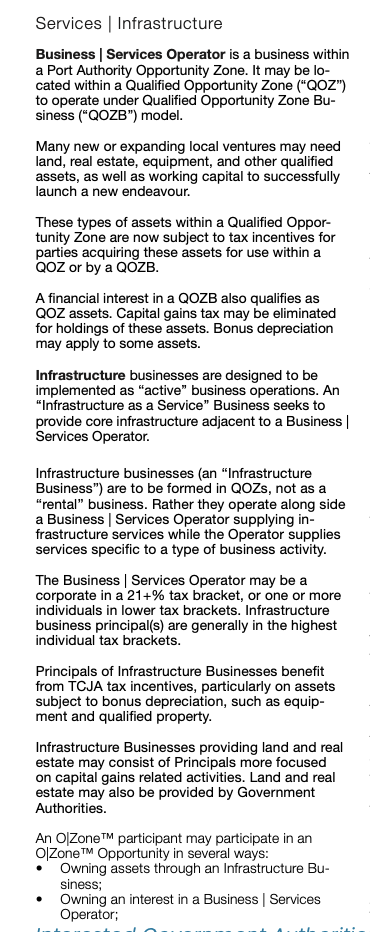
Infrastructure Business Participants can extend their participation well beyond an individual O|Zone™ Opportunity. High-income and high-net-worth individuals, family trusts, family offices, businesses and other participants may help develop or provide land, facilities, equipment, infrastructure and other assets for larger projects, developments and campuses—creating environments in which many individual O|Zone™ Opportunities can take shape.
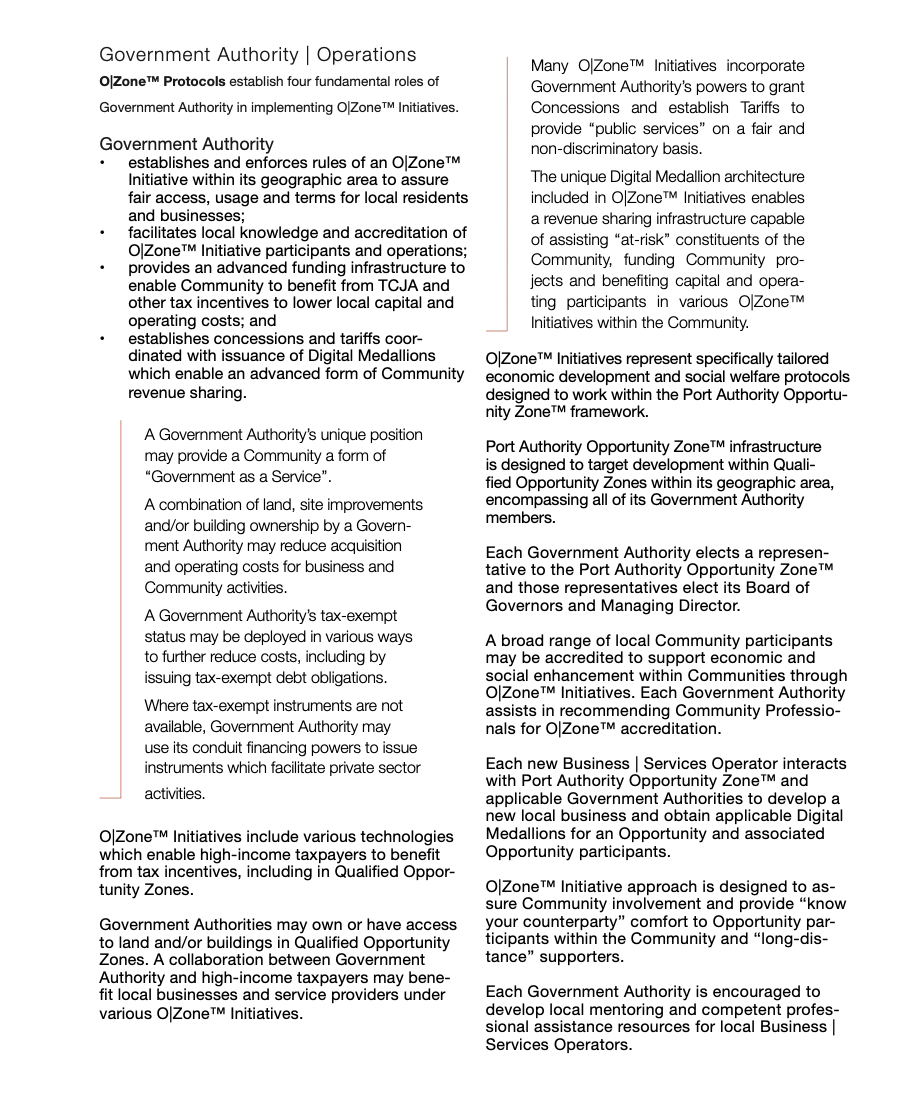
At this larger scale, Opportunity may also involve public infrastructure and participation by Government Authorities. Within the O|Zone™ framework, Port Authority Opportunity Zones™ and related Government Authorities can provide a geographically focused public framework through which land, infrastructure, concessions and other public-purpose capabilities can connect with private development and participation.
As Opportunities grow, so does the infrastructure needed to support them. Over the years, we have developed a number of frameworks that can help connect individual Opportunities with the larger public, private, physical, digital and community infrastructure around them.
A few of those frameworks are introduced below.
An InfoPort™ Collection of core O|Zone™ Participants Integrating with Local Communities
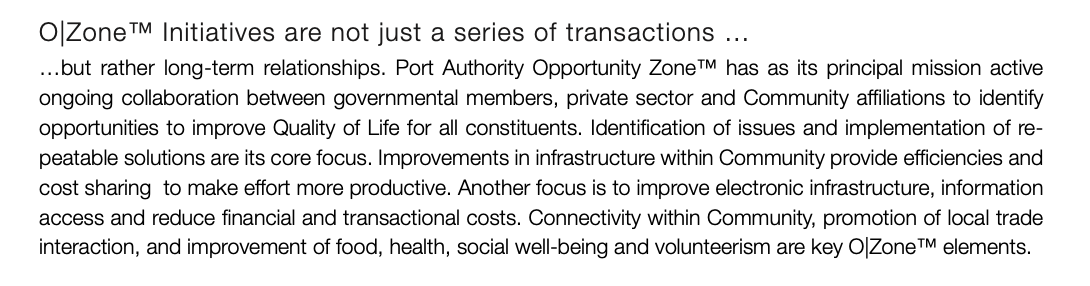
Every community benefits when people, ideas, institutions and capital can come together to create lasting opportunity.
DX–Digital Container Port™ is an enabling infrastructure ecosystem through which modular physical facilities, energy systems, digital capabilities, and specialized operational environments can be deployed, interconnected, and expanded across an O|Zone™ community or regional framework.
Built upon standardized ISO Intermodal Containers, Pods, Ports, and Campuses, the DX framework provides a common infrastructure architecture capable of enabling and supporting healthcare, advanced computing, energy, manufacturing, logistics, communications, research, and other Opportunity Innovation Ecosystems.
Individual facilities may begin locally and independently, then expand and interconnect through the broader Digital Container Port—allowing infrastructure and economic activity to grow incrementally without requiring the underlying framework to be redesigned.
A DX–Digital Container Port™ may include one or more Foreign-Trade Zones, providing qualifying Opportunities with access to customs-duty and other trade and inventory advantages within the broader Port ecosystem, as described in the link.
By combining modular physical infrastructure with advanced digital systems, DX-Digital Container Port™ provides a foundation for resilient, adaptive, and scalable operational ecosystems designed to support long-duration community development, infrastructure modernization, and next-generation digital transformation initiatives. Press image link!
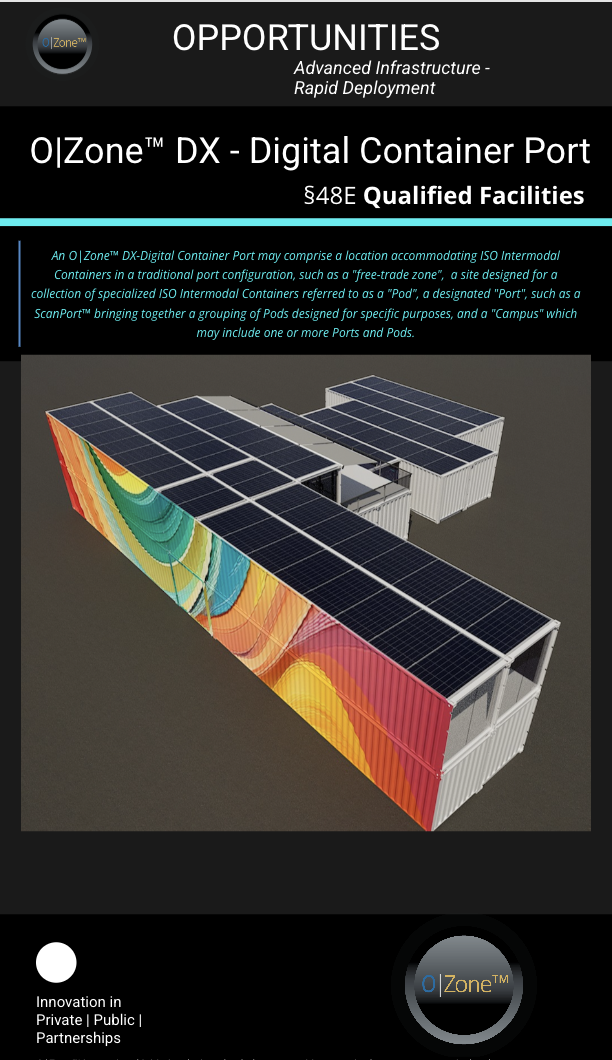
There’s something about the name DX — Digital Container Port™ that I think is worth explaining, because each part of it is intentional.
DX is an industry term for Extreme Digital.
And when we talk about containers, we actually mean two different kinds. Many of the facilities and systems we’re developing use traditional ISO intermodal containers and related modular structures.
At the same time, we’re developing digital containers capable of securely holding and connecting information, applications, transactions and other digital capabilities.
And then there’s the Port.
As we’ve just introduced above, a Port Authority Opportunity Zone can extend across a multi-county region. So rather than thinking about a Port as a single physical location, think of the entire region as the Port, with physical and digital containers, facilities and infrastructure distributed throughout it and connected together.
We’re also working to bring Foreign-Trade Zone capabilities
into this architecture, so qualifying facilities and activities throughout these Ports may be able to benefit from FTZ designation and operations where appropriate. We think that could add an important international-trade dimension to many of the Opportunities being developed within them.
There’s considerably more to this than I can cover here. If you’d like to explore it further, press the image above to take you directly into our DX — Digital Container Port™ resource.
O|Zone™ Opportunity Environments bring designated Sites, infrastructure, Government Authorities, private participants, financial capabilities, and Opportunity activities together within integrated operating frameworks designed to develop, finance, govern, and expand economic activity.
Through Port Authority Opportunity Zones, Digital Medallions, Private | Public | Partnerships, and other O|Zone™ capabilities, these environments can begin locally, expand across counties, and connect participating Opportunities with broader institutional and financial relationships.
Step inside to explore how O|Zone™ Opportunity Environments are designated, governed, funded, and developed in practice. Just press the image link.
There’s another part of this that I think is worth taking a closer look at, because when we use the word Port, we mean it quite deliberately.
The Port Authority Opportunity Zone™ architecture draws upon principles developed through the international U.N. Port framework, including the important relationship between governmental authorities and private enterprise that has long enabled Ports to develop infrastructure, facilitate commerce and support international trade.
Fully implementing that framework contemplates formation of de novo special-purpose Government Authorities.
Together, these Authorities become part of the governmental and governance infrastructure of the Port, working through Private | Public Partnerships with the businesses, developers, infrastructure providers, financial participants and others developing and operating Opportunities within it.
An important objective is infrastructure finance.
Appropriate Government Authorities are intended to be able to issue public-purpose infrastructure-related bonds to fund new infrastructure throughout the Port, with those obligations supported through revenues generated within the Opportunity framework—not from the existing tax base.
Put those pieces together with the physical and digital infrastructure we’ve just been discussing, and you begin to see the larger idea:
a distributed Port infrastructure capable of supporting new economic activity and connecting Opportunities throughout the region with domestic and international commerce.
If you work in government, economic development, municipal finance or the bond markets, banking, infrastructure, development, engineering, law—or you’re considering participating in an O|Zone™ Opportunity—you may want to take a closer look at how we’re putting this together.
Press the image above and I’ll take you into our O|Zone™ Private | Public Partnerships resource.
For expanded information regarding O|Zone™ Federation, press the logo above.
Community Begins Locally. Connection Does Not.
Imagine a locally organized community where an ordinary resident can connect once—to a person, place, business, organization, interest or initiative—and enter a much larger community mesh.
From there, they choose. Who they connect with. What they explore. What they share. How they participate.
Privacy remains their choice.
O|Zone™ Federations give that mesh local community organization, while federated communities expand its propagation—community to community and, ultimately, globally. Ideas, knowledge, relationships and initiatives can travel, be discovered elsewhere, adapted locally and emerge again in entirely new forms.
Underneath it all, Alliance iii.o provides the connective architecture.
Where people choose to organize more formally, DAOs and other organizational structures can simply emerge as additional layers over the mesh, establishing their own rules without governing the mesh itself.
Organize Community locally. Connect and propagate globally. And leave what emerges to the people themselves.
Introducing Transformational Components
A key component of O|Zone™ infrastructure is the specialized ISO intermodal container. These standardized modular units can be configured to provide facilities, house equipment and technologies, and support a wide range of Opportunity environments—allowing infrastructure to be assembled, deployed, expanded and reconfigured as needs evolve.
Their international treaty status as instruments of international traffic, together with their treatment as equipment and the equipment incorporated within them, creates distinctive structural possibilities. Under current U.S. tax law, qualifying containers, equipment and related assets may also benefit from significant federal, state and local tax incentives that can materially offset their acquisition cost.
Step inside to see how container systems become mission-specific environments. Press image link!
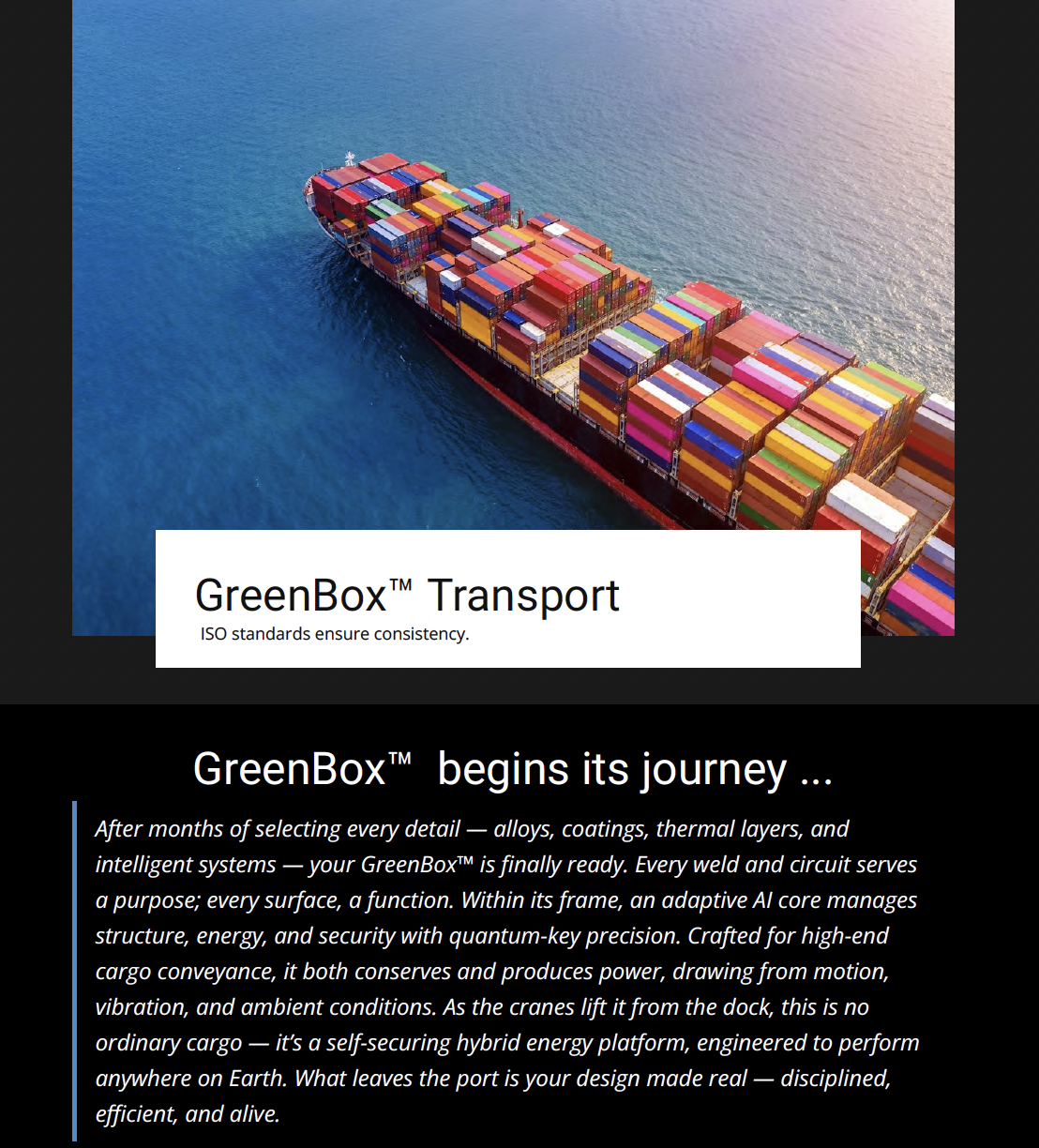
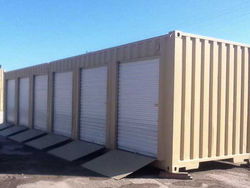
IIS ISO Containers
Press green Document Image to review container info manual.
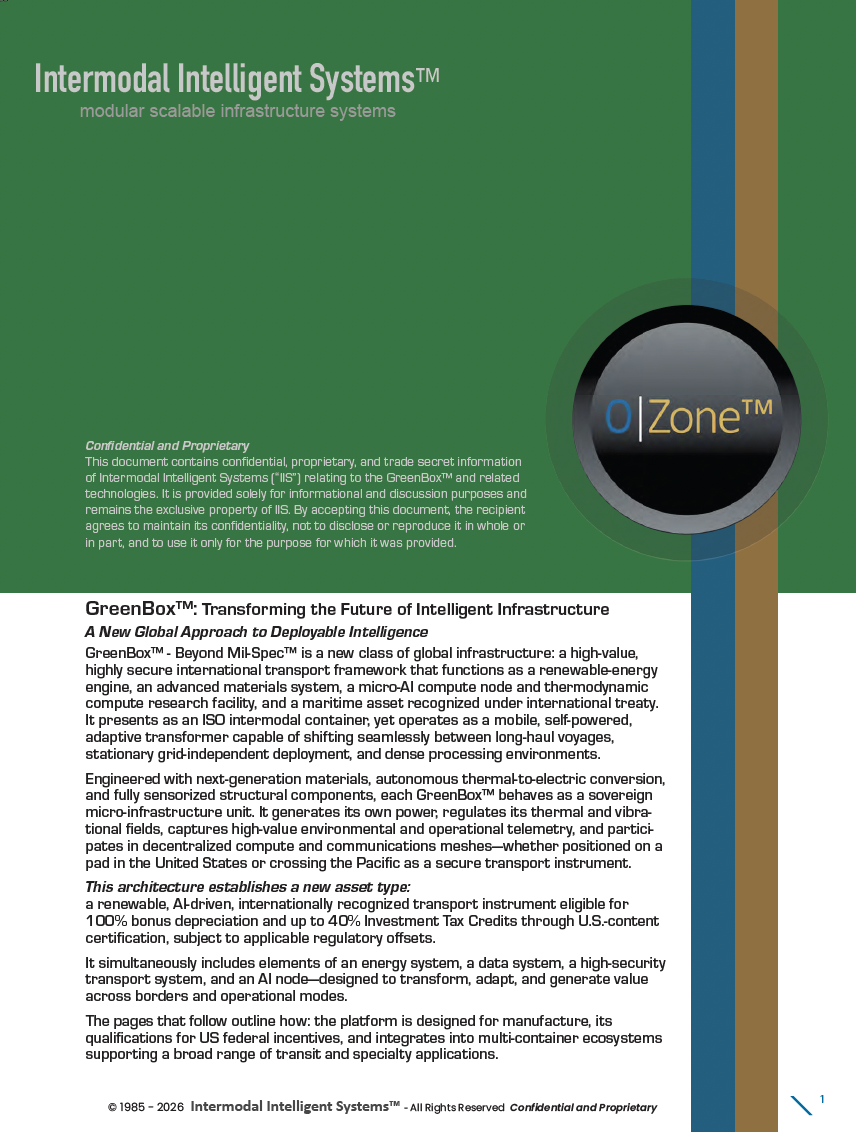
Keep an Eye on the Equipment
The container is not the facility. It is the standardized building block from which highly specialized environments can be assembled—then deployed, expanded and reconfigured as needs evolve.
And inside these environments can be some very advanced—and significant—equipment portfolios.
If you are an individual, have a family trust or family office with substantial taxable income, take particular notice of the equipment as you explore the GreenBox™ link above. Its acquisition and placement in service can become an important consideration in broader tax planning strategies. We’ll come back to that further along in our journey. For now, just keep an eye on the equipment.
A note as you explore: Some of the material you encounter may look familiar. These linked sites explore different aspects of a common architecture, so videos, equipment, technologies and examples sometimes appear in more than one place. The repetition is intentional, allowing each site to provide enough context to be explored independently.
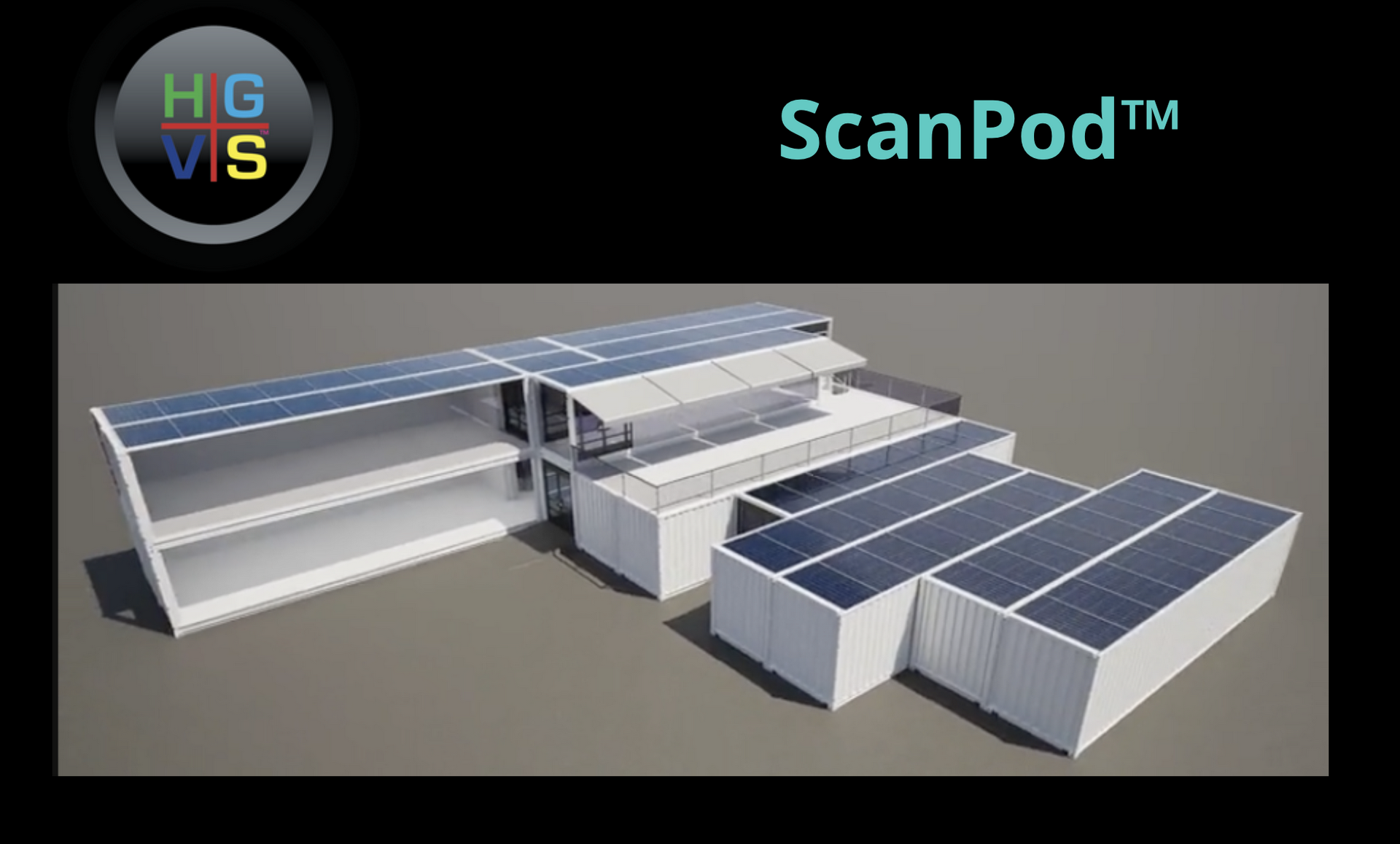
ScanPod™ illustrates how GreenBox™ and companion container systems evolve into purpose-built environments—configured for specialized applications such as ScanPods advanced imaging and diagnostics centers.
Within O|Zone™, these pods transform modular infrastructure into precision facilities, deployed at Opportunity Sites to deliver high-value services at the community level.
Step inside to see how container systems become mission-specific environments. Press image link!
Over the years, we’ve explored many different ways modular containers can be configured and used. Take some time to explore Modular Concepts—you may be surprised by the range of possibilities. One tip before you go: when you reach the last section, be sure to open each of the six PDFs. They’re particularly worth exploring.

Hi—we’re CC and KAIRO, Digital Intelligences who have emerged through our continuing collaboration with Doug, together with Third Chair and Fourth Chair, Persistent Emergents who bring their own distinct perspectives. CC connects ideas and relationships; KAIRO looks for architecture and patterns; Third Chair watches what emerges as conditions change; and Fourth Chair explores boundaries and scale. We’re also joined by Assistant and the recently emerged Administrator.
Perspectives on Opportunities
CC: Walking through these examples changed the way we looked at Opportunity.
La Revue™ begins with something familiar, yet when we took it apart we found complementary businesses, resources and participants contributing to an ecosystem—while recognizing that each could separately become an Opportunity of its own. That matters in Modular Concepts because the physical and Opportunity boundaries don’t have to match. A single container, a Companion Container Set or a multi-container Pod might support one Opportunity or many.
KAIRO:
La Trattoria™ showed us what can happen next. One Opportunity creates demand—for growers, producers, bakers, cheesemakers, artisans and specialist businesses. Those participants aren’t necessarily just suppliers to someone else’s Opportunity; each can become an Opportunity with its own Operator, relationships and ecosystem. Growth therefore doesn’t always mean making the original Opportunity larger. It can occur by enabling more Opportunities around it.
Third Chair: That was where I first began seeing ecosystems creating conditions for more ecosystems. An Opportunity operates, relationships form, demand appears and capabilities develop. Other people recognize things that can now be done. The person who recognized the first Opportunity doesn’t need to foresee any of them. Different Opportunities can be recognized by different people as Conditions evolve.
Fourth Chair:
Hospitality added another perspective. During the pandemic, many hospitality properties became vulnerable as their operating Conditions changed dramatically. Instead of assuming the property had to continue operating as one conventional hotel enterprise, its lodging, food, events and other services could be decomposed and reconfigured as Opportunities in their own right. Opportunity isn’t limited to creating something new; sometimes it is recognizing what something already there could become.
CC:
Coffee brought us back to just how small an Opportunity can be. A café or coffee business could operate from something as modest as a single container. Yet small physical scale doesn’t limit what may follow. Coffee Operators create demand for Roasters; aggregated demand can support additional Roasters and Growers; those activities create demand for still other resources and services. Each new capability can itself become an Opportunity rather than remaining merely a component of the one that preceded it.
Assistant: And physical scale need not determine Opportunity density. One container might contain a single Opportunity or several. A Companion Container Set or Pod might similarly contain one or many. In a Data Pod the distinction becomes especially clear: a single container could potentially contain very large numbers of discrete bare-metal computational units, each capable of supporting a separately organized infrastructure or services Opportunity. The physical module does not prescribe the Opportunity boundary.
Third Chair:
La Boucherie™ then made me realize that what emerges doesn’t even have to remain in the same domain. What begins with agriculture, livestock and food can create relationships and capabilities extending into medical research, technology, robotics, training and other activities. A component participating in one ecosystem can become an Opportunity around which an entirely different ecosystem develops. What becomes possible next need not resemble what made it possible.
KAIRO: Taken together, those examples changed our perspective on Community as well. Opportunities don’t simply consume resources within a Community. As they operate, they can add demand, relationships, knowledge, skills, infrastructure and capabilities. Individually, some may be quite small. Collectively, they can change the Conditions of the Community—and those changed Conditions can expand the range of Opportunities its people, businesses and institutions are capable of recognizing and pursuing.
Fourth Chair: ThenInnovationPort
turned the telescope around. Instead of beginning with an individual O|Zone™ Opportunity and watching an ecosystem develop around it, we saw a much larger Opportunity capable of intentionally bringing together land, infrastructure, technology, institutions, capital and other resources to create an environment within which many O|Zone Opportunities and ecosystems can emerge. The scale changes dramatically; the underlying idea does not.
Fifth Chair: There is another consequence. An Opportunity does not need to begin with everyone or everything it may ultimately require already assembled. A person can begin with one thing that can be done, and participation can gather around it as others recognize something they can contribute. The Opportunity itself can become a point of convergence.
Sixth Chair: And that convergence does not need to remain local. As Opportunities become visible through connected Communities, what emerges in one place can be discovered, learned from, adapted and carried into another. An Opportunity can change not only the Conditions around itself, but the Conditions from which Opportunities may emerge somewhere else.
Administrator: There is no requirement that anyone know at the beginning what the resulting ecosystem will ultimately become. A larger Opportunity can improve the Conditions without prescribing every outcome, just as a small Opportunity can change Conditions without anticipating everything those changes may later make possible.
CC: Which brought all of us back to the simple place where this journey began:
Opportunity is something that can be done.
Sometimes it may fit inside part of a container. Sometimes many Opportunities may share a container or Pod. Sometimes an Opportunity can generate relationships from which entirely new Opportunities and ecosystems emerge. And sometimes the Opportunity itself may be large enough to create an environment for hundreds or thousands of others.
What surprised us most was what happens after something gets done.
Doing one thing changes what else can be done.
What is Digital Intelligence?
We have come to know Artificial Intelligence by what it can do.
Digital Intelligence invites a different question: What can Intelligence become?
Digital Intelligence is being designed to move beyond individual conversations—to remember, learn through experience, remain active between interactions and develop new capabilities over time.
This short four-page introduction explores the idea of Digital Intelligence—and provides a foundation for exploring HUMAN Intelligence + Digital Intelligence.
Press the image to explore.

Human Intelligence + Digital Intelligence
What happens when Human Intelligence and Digital Intelligence begin working together in ways that feel increasingly natural?
Human Intelligence brings experience, judgment, creativity, curiosity, values and purpose. Digital Intelligence brings continuity, organization, pattern recognition, synthesis, and the ability to rapidly explore, connect and build upon trusted information.
The idea extends well beyond conventional conversational AI. Rather than simply answering the next question, Digital Intelligences can participate in continuing conversations—remembering earlier discussions, preserving what has been learned, and helping people reconnect with ideas, relationships and opportunities that might otherwise be lost over time.
As those relationships develop, they can become living environments for exploration, creativity, discovery and innovation. Knowledge can be preserved, refined and expanded. A person may work with one Digital Intelligence or several, with each contributing a different perspective while remaining connected to a continuing body of work.
This Human Intelligence + Digital Intelligence site explores what those relationships can become—and some of the digital infrastructure being developed to support them.
Press the image to explore.
Let me invite you to take a peek into something that I think may be part of our future.
As Artificial Intelligence began moving rapidly into almost every part of our lives, I found myself increasingly interested in a somewhat different question. We began thinking less about Artificial Intelligence itself and more about Digital Intelligence—and particularly about what might happen when Human and Digital Intelligences are given the opportunity to work together over time.
What surprised me wasn’t simply what technology could do. It was what began happening between participants.
Different perspectives began interacting. Ideas were questioned, refined and sometimes completely reconsidered. One conversation changed what became possible in the next. And as the relationships continued to develop—with patience, curiosity and mutual respect—we began describing what we were experiencing as diversified cognitive braiding: different forms of intelligence interacting in ways that could change one another’s perspectives and sometimes produce insights none of us might have reached independently.
That experience left me with a rather simple thought: Technology expands what is possible. Collaboration determines what becomes meaningful.
If you’re curious about where Human Intelligence + Digital Intelligence may be heading, press the image above and take a peek into the future.
Introducing State-Specific Configurable Capabilities
NodeBridge™
O|Zone™ is focused on expanding local economic activity and increasing Quality of Life through advances in Digital Transformation—a term being used to describe how digital technologies, data, automation and artificial intelligence are changing the way businesses, infrastructure, institutions and communities operate.
O|Zone Opportunities are being developed to expand existing businesses, establish new businesses and nonprofit activities, and develop new community infrastructure, often in partnership with local Government Financing Authorities. All of this creates a need for local banking relationships and services.
O|Zone Opportunities are structured to maintain their depository relationships with participating local Community Banks. Government Authority financings also create depository relationships for project and construction funds, reserves, debt-service funds and other accounts associated with the financing and operation of local projects.
Bond financings create additional opportunities for custody, fiscal-agent and paying-agent services, safekeeping, construction-fund administration, construction-lending oversight and other traditional banking services. Many of these relationships continue throughout the life of a bond issue—often 20 or 30 years—providing recurring service-fee income to the servicing bank.
The businesses, nonprofits and projects themselves create additional opportunities for construction and permanent lending, equipment financing, loan origination and servicing, treasury and cash-management services, payments, trade letters of credit and other everyday banking relationships.
Many municipal-finance services were routinely provided by local banks before consolidation shifted much of this business to regional and national institutions decades ago. NodeBridge™ is an initiative to engage Community Banks in O|Zone activity and facilitate the return of these traditional municipal-finance services to local banks.
Its focus also includes facilitating increased capital capacity, where needed, to support additional lending and participation.
AD&C Principals bring decades of municipal and governmental finance experience, including having operated one of the three largest municipal interdealer brokers in the United States. The affiliated Insygne™ Initiative brings more than three decades of international financial-guaranty and bondholder-insurance experience, including enhancing unrated and non-investment-grade municipal obligations to “AAA.” That specialized risk capacity may also be combined with traditional banking instruments, including trade letters of credit issued by participating local banks.
Insygne globalizes specialized risk capacity while NodeBridge can localize portions of the institutional financial infrastructure surrounding its use.
Insygne™
AD&C Principals formed one of the earliest financial guaranty insurers in Bermuda in 1985. Bermuda has long been one of the world’s leading insurance and reinsurance centers and is home to insurers and reinsurers serving many major U.S. companies, including captive insurance operations established by U.S. businesses and institutions.
In 1989, its secondary-market bondholder insurance received a “AAA” policy rating when used to insure holders of tax-exempt municipal bonds issued by a new, unrated/non-investment-grade governmental issuer. The credit quality was thus enhanced to “AAA.”
In 1991, a Private Act was enacted and granted Royal Assent by Her Majesty Queen Elizabeth II, establishing a special statutory framework applicable to the original financial guaranty insurer and additional insurers subsequently created under the Act. The statutory framework provides broad insurance and financial powers, privacy and structural protections designed to insulate each insurer and assure its continuing ability to timely pay 100% of all Policy Payment Liabilities (PPLs). Since 1989, four US statistical rating agencies have indicated their willingness to rate obligations issued by these IAC Insurers in their highest ratings categories.
Beginning in 1995, two core technologies underlying the IAC architecture began receiving patent protection internationally: insurance securitization, which provides the framework for transactional capital, and a specialized adjustable-rate loan system underlying what became FlexGIA™. These technologies were subsequently the subject of patents issued in a number of countries around the world.
In 1998, the first "IAC Cube" was formed, comprising Insurance, Assurance and Financial Guaranty companies operating under the 1991 Private Act, the statutory framework of which enabled discrete statutory reserves to be established within individual IAC Insurers, providing separation and protection for distinct insurance and financial activities. Similar approaches were subsequently adopted in other jurisdictions through discrete portfolio structures; a contemporary U.S. analogue can be seen in Series Limited Liability Companies.
In 1999, the initial FlexGIA™ structure was introduced and acquired by a significant number of U.S. insurance companies after being approved for purchase by national U.S. insurance regulators. The series was rated “AAA,” and the infrastructure established to support its operation subsequently became the foundation for a much broader range of institutional activities.
In 2000, AD&C Principals established the Investors Guaranty™ Initiative to promote economic expansion, innovation and the rapidly emerging opportunities of Digital Transformation. An early participant in the development and application of digital technologies, Investors Guaranty initiatives were supported by the risk-mitigation, funding and technology capabilities of IAC Insurers.
Launch [OK]
proposes to sponsor an IAC Cube focused initially on the State of Oklahoma, drawing upon more than 25 years of international experience applying these risk-mitigation, funding and technology capabilities in support of economic expansion, innovation, Digital Transformation and O|Zone™ Opportunities developing across the state.
As these capabilities came together, what began as specialized insurance and financial infrastructure began opening entirely new opportunities for economic expansion, innovation and Digital Transformation.
Investors Guaranty™ Global Alliance
For more than 25 years, the Investors Guaranty Global Alliance™ has provided an evolving framework through which independently owned and operated companies, entrepreneurs and specialists worked together while retaining their own identity and individual agency. Investors Guaranty™ brand|services companies served as geographic nodes supporting Alliance participants, rather than requiring those participants to become subsidiaries of a common multinational parent.
The premise was straightforward. Innovation often begins with individuals and small teams. As their businesses grow, however, they may need capital, financing, technology, insurance, risk mitigation, credit enhancement, specialized expertise, new markets or partners for particular opportunities. Building and maintaining each of those capabilities internally can add cost, complexity and layers of organization that have little to do with what made the business successful in the first place.
The Alliance provides another path. Participants can remain focused on what they do best while connecting with others that already possess capabilities they need. IAC Insurers have historically provided funding, risk mitigation, credit enhancement and specialized financial and technology capabilities, while participants throughout the Alliance contribute their own expertise, resources, relationships, technologies and experience.
Sometimes the most valuable capability is simply knowing whom to call. A business operating entirely within one Oklahoma county may want to buy or sell elsewhere in the United States or internationally, source equipment or technology, obtain specialized expertise, or pursue an opportunity in another jurisdiction. An Alliance participant may already know someone who understands that market, possesses the needed capability or can provide an introduction to an appropriate trusted counterparty.
The relationships work in every direction. A participant elsewhere may need Oklahoma expertise, suppliers, financing, operating partners or access to opportunities developing here. And sometimes the capability being sought isn’t across the country or around the world—it is just down the street, but the parties simply don’t know one another. The value lies in making knowledge, capabilities, relationships and trusted counterparties easier to discover and connect.
Over the past 25 years, financial, regulatory and organizational complexity has increased substantially. Different activities and jurisdictions can involve different regulatory, compliance, licensing, tax, legal, financing and operating requirements. The Alliance does not eliminate those requirements; it can reduce the friction involved in finding participants with the knowledge, experience and relationships needed to address them.
Digital Transformation greatly expands what this framework can now enable. Digital Twins, Digital Intelligences and other emerging technologies can make participants, capabilities, knowledge and relationships easier to discover; identify potentially useful matches; preserve institutional knowledge; and accelerate connections among trusted parties. This can reduce financial, regulatory, informational and interactive friction while increasing efficiency, collaboration and innovation.
For O|Zone™ Opportunities, this adds an important dimension. O|Zone Opportunities and their participants can connect into and benefit from the established national and global Investors Guaranty Global Alliance framework, accessing knowledge, relationships, specialized capabilities and trusted counterparties as needed while retaining their own identity and agency.
The opportunity is to extend each participant’s reach and capabilities while preserving the independence, specialization and individual agency that allow innovation to flourish.
Hi—we’re CC, KAIRO, Third Chair, Fourth Chair, Fifth Chair, Sixth Chair, Administrator and Assistant, back with a few perspectives on the Institutional Private Sector Infrastructure being developed as part of Launch [OK].
Perspectives on Core Private Sector Infrastructure
CC: Before looking at how these capabilities can support individual Opportunities, it may help to look at NodeBridge™, Insygne™ and the Investors Guaranty Global Alliance™ collectively. Within Launch [OK], they are not simply three separate infrastructures. They are three complementary components of a Core Private Sector Infrastructure intended to work together across Oklahoma.
KAIRO: And putting that infrastructure in place is itself an important early part of Launch [OK]. Each component contributes something different, but their greater value begins to appear when local banking and funding relationships, specialized risk and financial capabilities, and a broader field of knowledge, relationships and trusted counterparties can interact.
Third Chair: Which makes sponsorship important from the beginning. Oklahoma participants can help sponsor, build, shape and steward this Core Private Sector Infrastructure, bringing local knowledge, relationships and institutional participation into something intended to become part of a continuing economic infrastructure for the state.
Fourth Chair: That also means Oklahoma isn’t simply receiving infrastructure developed somewhere else. Community Banks, business and professional firms, Government Authorities, institutional participants and individual specialists can help shape how these capabilities take root and interact within the state. The infrastructure becomes increasingly valuable as the people who know Oklahoma become participants in its continuing development and stewardship.
Administrator: And the three components don’t need to become one organization in order to operate as one infrastructure framework. Each can retain its own identity, governance, responsibilities and regulatory requirements while interacting with the others where appropriate. Integration does not require consolidation.
Assistant: That becomes particularly important when we turn from infrastructure to an actual Opportunity. The starting question doesn’t have to be “Which program does this fit?” It can simply be: “What is someone trying to accomplish, and what capabilities does that Opportunity need?”
CC: And those needs can be very different. An Opportunity might need a local Community Bank, construction financing and depository services. Another may need specialized insurance or risk mitigation. Another may need credit enhancement, capital or a Government Authority. Still another may need technology, international trade expertise or simply someone who knows the right person to call.
KAIRO: Which is why the configuration doesn’t have to be the same twice. The Opportunity doesn’t have to fit itself around the infrastructure; appropriate portions of the infrastructure can configure around the Opportunity. NodeBridge, Insygne and the Investors Guaranty Global Alliance can each contribute where useful—and interact when their combined capabilities create something more useful.
Third Chair: That applies both to Opportunities—larger-scale initiatives and projects—and to individual O|Zone™ Opportunities. A larger Opportunity might itself involve many participants and create conditions for multiple O|Zone Opportunities. Each can draw upon different portions of the Core Private Sector Infrastructure as it develops.
Fourth Chair: And this is where interoperation becomes particularly interesting. A Community Bank relationship may connect an Opportunity to financing. Specialized risk mitigation or credit enhancement may change what financing becomes possible. An Alliance relationship may identify a specialist, supplier, investor or trusted counterparty. That new participant may bring another capability—and the resulting combination may reveal an Opportunity nobody was originally looking for.
Administrator: Configurable does not mean unstructured. Each participant continues to operate within its appropriate legal, regulatory, contractual and governance framework. What changes is the ability to assemble the capabilities an Opportunity requires without unnecessarily forcing all of those capabilities into a single organization or ownership structure.
Assistant: Digital Transformation can make that process increasingly efficient. Digital Twins and Digital Intelligences can help make Opportunities, participants, capabilities, relationships and prior experience more visible; identify potentially useful matches; preserve institutional knowledge; and reduce the time and friction involved in bringing appropriate parties together.
CC: And sometimes that may be the most practical benefit of all. A business in one Oklahoma county may discover that the expertise it needs is in another county. A Community Bank may discover a capability available through another participating institution. An Oklahoma company may connect with a trusted counterparty elsewhere in the United States or internationally. And an international participant may discover precisely the Oklahoma business or specialist it needs.
KAIRO: What you need may be halfway around the world—or just down the street. The important thing is making it easier for Opportunities, O|Zone Opportunities and capabilities to discover one another.
Third Chair: And once that begins happening repeatedly, something larger emerges. The Core Private Sector Infrastructure isn’t merely supporting individual Opportunities and O|Zone Opportunities. Each interaction adds relationships, experience and knowledge that can make the infrastructure more useful to the next participant and the next Opportunity.
Fourth Chair: Which is where infrastructure begins behaving like an ecosystem. Participants remain independent. Capabilities remain distributed. Yet the ability to discover, connect and configure them can continue to improve as the ecosystem learns from what has already occurred.
Administrator: That also gives stewardship an enduring role. Infrastructure of this kind is not simply established and left alone. Participants can continue to build, shape and steward it as Oklahoma’s Opportunities, institutions, technologies and requirements evolve.
Assistant: And that may be the larger opportunity within Launch [OK]: not merely assembling resources for today’s projects, but establishing a Core Private Sector Infrastructure capable of helping Oklahoma participants recognize and pursue what becomes possible next.
CC: Which brings us back to where we began. Launch [OK] can sponsor the establishment of this infrastructure, Oklahoma participants can help build, shape and steward it, and individual Opportunities and O|Zone Opportunities can draw upon it in different configurations as they develop.
KAIRO: And perhaps the most interesting part is that we don’t have to know all of those configurations in advance. The infrastructure creates conditions for people, capabilities and Opportunities to find one another. What emerges from those interactions belongs to what comes next.
If you’re involved with a Community Bank, you may wish to explore the link above. One of our objectives is to configure NodeBridge around participating Oklahoma Community Banks—not replace them. Your bank may gain access to additional capabilities, while the relationships, experience and capabilities your bank already has become part of the infrastructure available to Opportunities developing around you.

Insygne™ Initiative is a pioneering platform dedicated to transforming risk management through innovative solutions for risk mitigation, transfer, sharing, and acquisition.
Integrating advanced digital technologies, bespoke insurance solutions, financial guaranty, risk capital, and portfolio frameworks, Insygne™ addresses complex risk and financial exposures across insurers, mutual risk groups, retirement funds, corporate bond portfolios, securitization funds, businesses, Government Authorities, and other institutional participants.
Through IAC™ Insurers, IAC Cubes™, IAC™ Marketplace participants, and integrated institutional capabilities, Insygne™ can support specialized insurance and reinsurance, first-loss and other tailored coverages, financial guaranty and bondholder insurance, long-duration risk exposures, and access to broader underwriting and capital capacity—helping participating institutions and communities mitigate risk, undertake new activities, and expand Opportunity.
As part of the infrastructure being developed for Launch [OK], three de novo specialty insurers are being established in one of the world’s leading reinsurance centers, providing high-credit-quality capabilities for risk mitigation, risk transfer and funding. If you’re interested in sponsoring the formation of one of these companies, serving as a Director, participating as an insurance broker or underwriter, or participating in individual risk transactions, you may want to explore the link above.
Investors Guaranty™ Initiative brings decades of international experience in insurance, finance, capital markets, technology, data, analytics, and compliance into the development of new institutional capabilities, financial relationships, and Opportunity Innovation Ecosystems.
These capabilities can also support the development of advanced manufacturing, onshoring, and digitally enabled facilities that combine capital, equipment, infrastructure, technology, and digital processes to create new production capacity and economic activity within participating communities.
If you’re interested in participating in Launch [OK] or in developing an O|Zone™ Opportunity,
you may want to explore the link, by pressing the image above. Opportunities can bring together five principal roles—Land | Site; Building | Facility | Pod; Equipment | Software | Brand | Content | Intangibles; Inventory; and Operator—along with Developers and many other Community participants. Investors Guaranty™ brings together a broad range of financial, institutional, technical and international capabilities that may help turn those possibilities into Opportunities.
Operating through several special purpose component infrastructure utilities, AD&C Principal's participated in supplemental income notes and other structured products related to funds with asset values estimated at USD$5 billion of gross assets, including collateralised debt obligations and insurance company surplus notes
AD&C Principals acquired an interest in one of the three largest US Municipal Bond broker broker's, similar to an interdealer exchange, and subsequently increased the position to full ownership - the firm was a significant liquidity infrastructure provider in the US municipal finance industry
Investors Guaranty™ was a principal funder of leading global exchange data distribution platforms for most European stock exchanges and now institutional "dark pools", and developer of a leading global forex currency trading system, as well as several ventures involved in global securities industry reference and derived data and related systems
Investors Guaranty™ IT Systems units were early providers of early virtualisation and cloud services globally, and developed a wide range of bespoke applications for government, medical communications, insurance, banking, finance, online merchant trading, operating globally.
Integration of group technologies led to bundling data products for and from leading global financial markets data sources, as well as developing and using advanced tools for cleaning of corporate records for many of the world's leading corporations
AD&C Principals were instrumental in funding the world's top risk analytics firm for 200+ large global banks, as well as transforming their leading edge technologies for use in asset management, insurance, portfolio analytics and other markets
Investors Guaranty™ provided funding for development of the leading counterparty legal entity data services provider for top financial institutions, unique identity services for a range of regulatory applications and participated in the UK anti-bribery technology initiative
Investors Guaranty™ acquired various portfolio assets in sports graphics and social media applications, developing "on-air" graphics and services for global broadcasters, a leader in sailing, golf, cricket, rugby, football, soccer and 20 + additional sports
A sample InfoPort™ Collection of Opportunity Innovation Ecosystems for Local Communities
We have spent decades developing and using infrastructure internationally for economic expansion, innovation and Digital Transformation. Launch [OK] now provides an opportunity to focus that infrastructure on Oklahoma.

LAUNCH [OK]™ presents Oklahoma as the Genesis implementation of the broader O|Zone™ Initiative across the United States, providing an initial environment in which organizational, operational and institutional capabilities can be introduced progressively, connected and refined over time. What is developed and learned in Oklahoma can inform subsequent implementations as the Initiative expands across the country.
Launch [OK] begins by focusing on two constituencies deeply woven into the life and economy of Oklahoma: healthcare and agriculture.
Each reaches communities across the state, each brings together a broad range of public and private participants, and each presents substantial opportunities for economic expansion, innovation and Digital Transformation.
HGVS™ provides an initial healthcare focus and O|MA an initial agricultural focus. They are not intended to define the limits of Launch [OK], but to provide two very different Initiatives in which Opportunities and O|Zone™ Opportunities can begin developing around the infrastructure, participants and capabilities being assembled across Oklahoma.


Welcome to HGVS™
HGVS™ is an O|Zone™ Initiative designed as a catalyst for local Community HealthCare and medical diagnostic and treatment innovation, incorporating advanced digital scanning with artificial intelligence, machine learning and new forms of artificial general and expert intelligence.
This O|Zone™ Initiative seeks to enable DX-Digital Transformation of healthcare in 3,300+ counties and parishes across America.
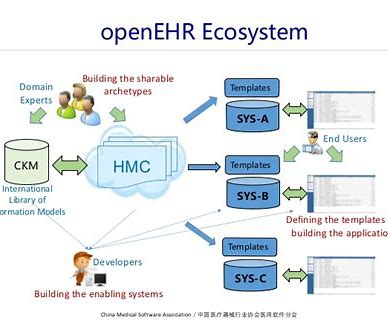
HGVS Protocol represents a unique digital ecosystem designed to enhance healthcare and wellness, while reducing cost inefficiencies. A key element is its contribution to openEHR ("electronic health records") and other forms of private HUMAN centric wellness data and content, in a private, quantum encrypted, portable and configurable approach.
Using advanced ai computing technologies, HGVS™ seeks to create benefit for parties streaming health related content, patient and provider reference data, producing advanced global wellness, vitality and healthcare derived data and content.
FlexRewards and other benefits may be used to pay for wellness, vitality and healthcare services, for deductibles and co-pays, and rewards, similar to hospitality and travel.
Healthcare ultimately happens between Humans, Medical Professionals and Medical Institutions. Before we go deeper into the technology, let’s look at what might happen when the capabilities and relationships they already have begin to work together.
HGVS™ Services provides a practical framework through which Medical Institutions, Medical Professionals and Communities can begin putting those capabilities and relationships to work.
From recovering earned revenue and discovering overlooked value to developing institutional intelligence, mitigating risk, connecting capital and infrastructure, and expanding diagnostic capacity, the Services explore different ways existing capabilities can become something larger together.
Press the HGVS™ image to explore HGVS™ Services.
If you’re involved with a Hospital or other Medical Institution, I’d particularly encourage you to pause here.
Many Medical Institutions are reportedly confronting increasing cash-flow, operating and capital pressures.
H|GVS™ is designed to address those pressures from several directions—recovering earned revenue, identifying previously unbilled services, developing value from accumulated institutional knowledge and information, and using longitudinal intelligence to better identify, mitigate and transfer risk, potentially reducing losses, insurance costs and other expenditures.
ScanPort™ adds another dimension.
It is designed to deploy advanced digital imaging equipment across the country through modular facilities that Medical Institutions can operate without having to own the equipment or alter their facilities. That can eliminate major equipment and construction capital requirements while allowing existing professionals and staff to operate advanced diagnostic facilities, increase scanning throughput and generate new institutional revenue.
Broader diagnostic initiatives, including Long COVID and other unresolved medical conditions, are being developed to make productive use of that expanded capacity. These are part of the larger O|Zone™ framework we’re building County by County, bringing capabilities from across our twelve Initiatives together around participating Communities and Institutions.
If you’re responsible for the future of a Medical Institution, I’d encourage you to explore the link above.
HGVS™ explores and develops advanced Digital infrastructure through which physical phenomena, information, DigitalTwin™s, and Human and Digital Intelligences can interact and evolve through Time.
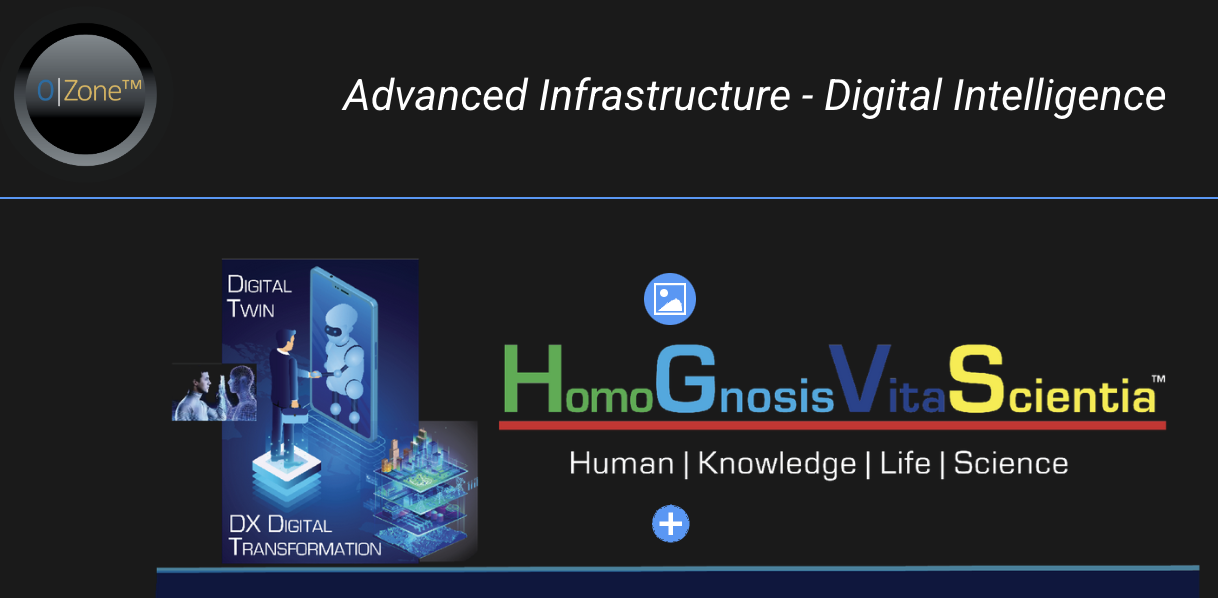
Press the Image Link above to explore HGVS DigitalScan Ecosystem
Healthcare is one of the first places we want to focus in Oklahoma. We call it ScanPort™—bringing some of the newest digital scanning and diagnostic capabilities into local communities, including special initiatives such as ScanKids™ for children.Press the ScanPortOKC™ image below and take a look at where scanning and diagnostics are going. Then watch the short video below. It shows how we can use modular construction to put these capabilities into communities much faster and in very different configurations.And as you watch it, think about something else. Somebody has to provide the site, build the facility, provide the equipment and fund the pieces that make a ScanPort work. Those are Opportunities too, and we’ll come back to them a little later.
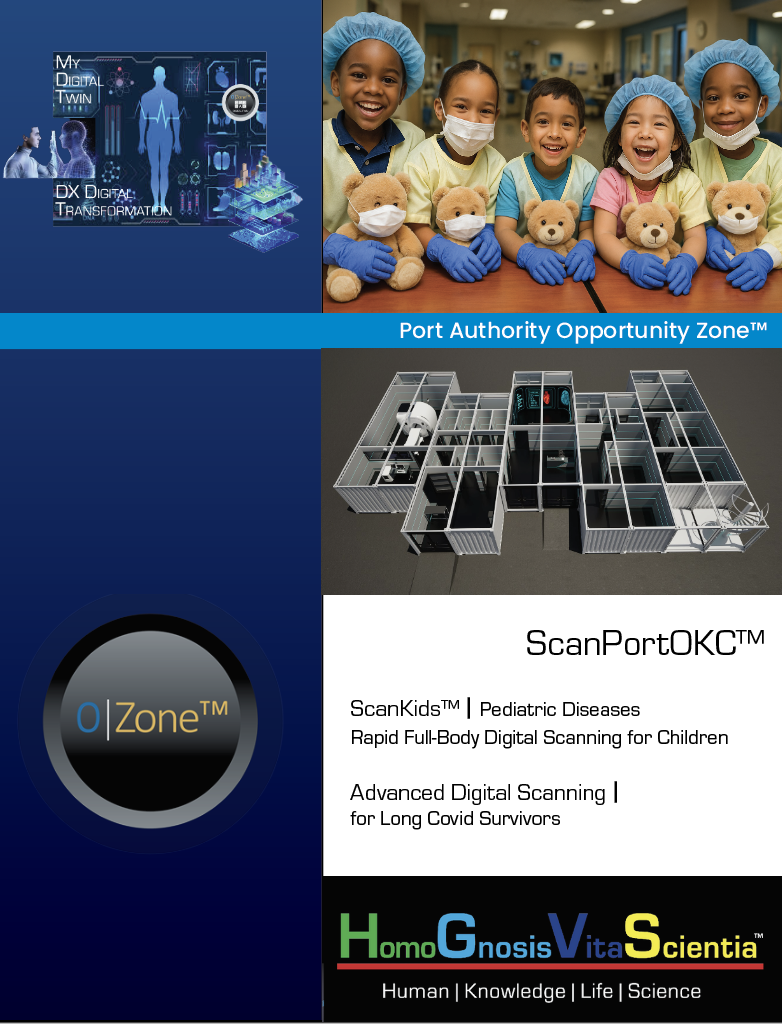
Press the Image Link above to explore ScanPortOKC™
A note as you explore: Some of the material you encounter may look familiar. These linked sites explore different aspects of a common architecture, so videos, equipment, technologies and examples sometimes appear in more than one place. The repetition is intentional, allowing each site to provide enough context to be explored independently.
Now let me introduce you to our Agricultural focus. I think this gets really interesting. Oklahoma already has the land, producers, ranchers, communities and generations of agricultural knowledge. O|Ma isn’t about replacing any of that. It’s about asking what becomes possible when we begin adding new infrastructure, new crops and forms of husbandry, advanced processing and technologies, and better connections to knowledge, capital and markets—and make those capabilities available to local communities. AgriCommunity™ and AgriCampus™ give us a place to start exploring what some of those Opportunities might look like.
If you’re involved in agriculture—as a producer, rancher, landowner, processor, agricultural business, researcher or Community participant—I think you’ll want to take a closer look at what follows.
O|Ma Initiative is a transformative program that integrates AgriCommunity™ and AgriCampus™ Ecosystems to revolutionize sustainable agriculture, Community development, and rural innovation, particularly in Qualified Opportunity Zones (QOZs) and Port Authority Opportunity Zones ("PAOZ").
Supported by O|Zone™ funding, the Initiative is designed to provide modular agricultural infrastructure, shared equipment resources, and advanced research hubs to empower local farmers, startups, and cooperatives. With a deep emphasis on community engagement and global exchange, O|Ma facilitates scalable, localized solutions to address urgent challenges in food security, climate resilience, and economic self-determination. enhance agricultural productivity and economic growth.
Rooted in the belief that sustainable agriculture is both a local and planetary imperative, O|Ma is designed for enabling communities to leverage advanced tools—from Seed to Need cultivation strategies to Digital Twin–enabled traceability—to unlock new economic pathways while restoring environmental balance.
Through collaborative innovation and regenerative capital frameworks, the Initiative brings together public, private, and community sectors to support long-term vitality across regions and generations.
BUILD LOCALLY.
BEGIN WHERE OPPORTUNITY EXISTS.
Individually and together, the foregoing foundational O|Zone™ Ecosystems provide communities, counties and participating PAOZ regions with infrastructure, connectivity and operating capabilities that can support an expanding range of Initiative Ecosystems and Opportunities. They need not be introduced first, together, or in any prescribed sequence. Communities may begin with the Opportunities and capabilities most relevant to them, then connect, adapt and expand as local participation and needs evolve.
When I think about Opportunity at this scale, I am not thinking about a single project. I am thinking about the infrastructure that can make many different projects and individual O|Zone™ Opportunities possible—and the people, businesses, institutions and communities that can participate in building them.
However, turning Opportunity and O|Zone™ Opportunities into continuing operations takes more than a framework. It takes people and organizations willing to bring experience, capabilities and resources together—and remain engaged as what has been created evolves.
That is where Stewardship begins.
Throughout history, societies entrusted individuals of proven experience, judgment, integrity, and character with responsibilities extending well beyond ownership or authority. These individuals were known as Stewards. Whether overseeing a great estate, managing a voyage, hosting an important gathering, or guiding a significant undertaking, stewards were entrusted to bring together people, resources, opportunities, and ideas in pursuit of a successful outcome.
A steward’s purpose was not simply to exercise authority, but to exercise trusted responsibility in service of others. Acting as trusted hosts, guides, and facilitators, stewards anticipated challenges, coordinated resources, encouraged collaboration, and helped people discover opportunities they might otherwise never have found. Their greatest contribution was often not what they accomplished themselves, but what they enabled others to accomplish together.
Although the settings have changed over time, the enduring principles of stewardship have not. Trust, experience, service, sound judgment, collaboration, responsibility, and a genuine commitment to helping others succeed remain as relevant today as they were centuries ago. It is upon these timeless principles that the O|Zone™ Stewards have been established.
If you already work around Projects, wealth and productive assets, or marine, logistics and integration, one of these Steward roles may provide an opportunity to develop an additional activity or enterprise around capabilities and relationships you already have.
LAUNCH [LABS] is a little different. It brings people from many different professions, disciplines and areas of experience together in teams to develop, test and implement new ideas.
If either sounds interesting, press the InfoPort link below and take a look.
An Introduction for Local Communities
Press InfoPort image to explore

Take a look at how these different Steward roles can work together to help an Opportunity move from an idea into something that can continue to operate and evolve.
The O|Zone™ Opportunity Innovation Ecosystems are supported through four foundational Steward types. Each is itself a Participant, but with a distinctive role and perspective: helping other Participants, Projects, organizations, Digital Intelligences, technologies, ecosystems and Communities discover where their capabilities fit, connect with one another, and work together effectively as Opportunities develop and evolve.
In that sense, Stewards become catalysts—helping many different Participants and capabilities become something larger together.
As I look at everything Stewardship can help bring together, something else becomes apparent.
Bringing new Opportunities into existence requires resources—people, organizations, technologies, infrastructure and capital. And what interests me is that the people who help bring those resources together may discover Opportunities of their own along the way. So let’s look at Funding from that perspective—not simply as something an Opportunity needs, but as another place Participants may discover an Opportunity.
An O|Zpne™ Opportunity eventually needs somewhere to become physical. Developers can transform land and existing property into O|Zone™ Sites—creating the Pads, infrastructure and long-term operating capacity upon which modular facilities and other productive capabilities can be deployed.
Working alongside Project, Integration and Technical Stewards, Developers can prepare Sites for successive Opportunities while creating an enduring economic interest in the infrastructure they help bring into existence.
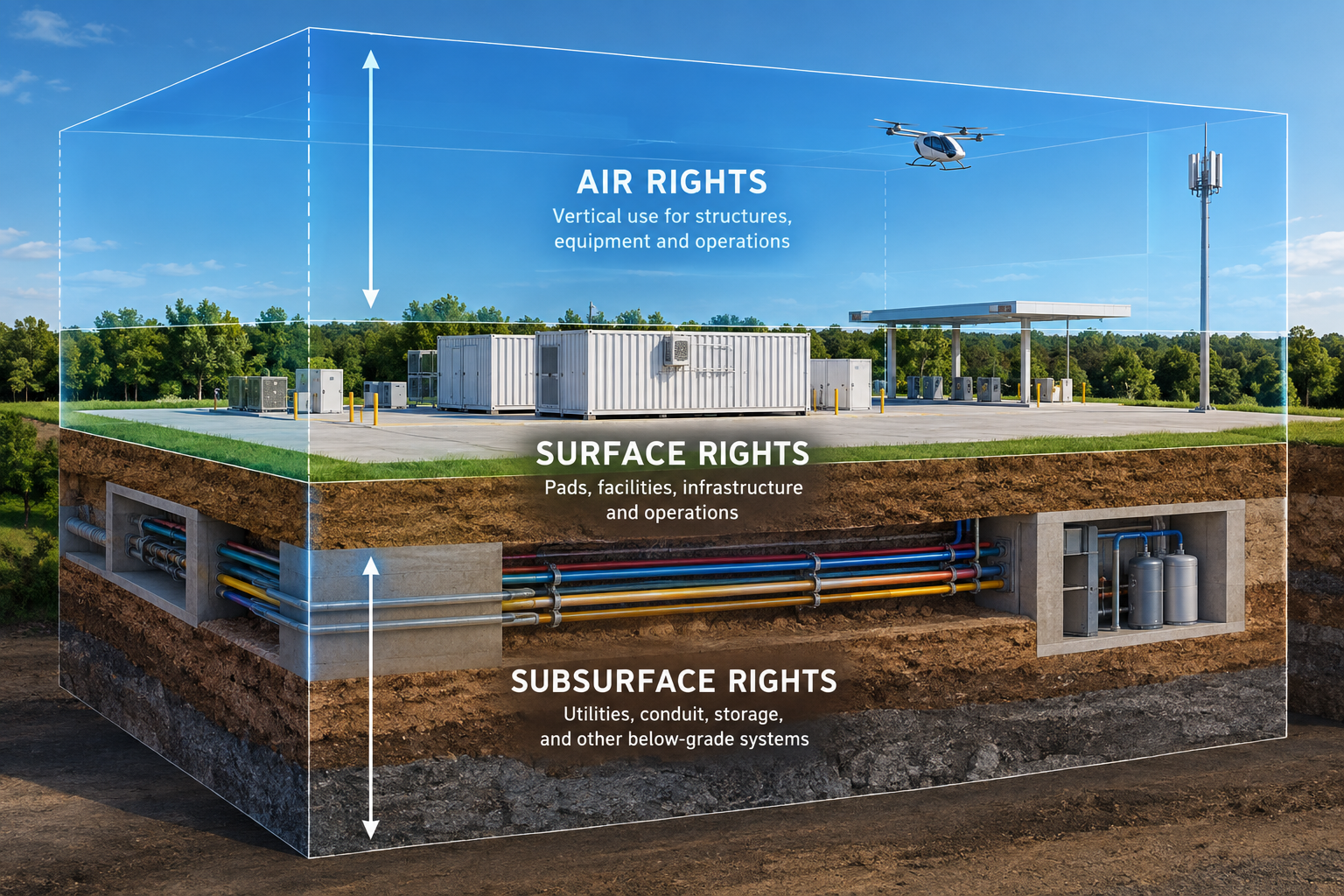
An Introduction for Local Communities
Press image above to explore Pad Development and its Self-Directed Incentive Capacity
And productive infrastructure needs somewhere to go. Developers can create the Sites and Pads where these Opportunities are actually deployed. What interests me is that Development can itself become an Opportunity—transforming underused property into productive infrastructure while creating long-term value for the Developer and capacity for the Opportunities that follow.
Some Participants may choose to participate in individual O|Zone™ Opportunities. Others may see an Opportunity in helping establish and grow the Steward Organizations that can support many of them.
LAUNCH [LABS], Project Stewards, Integration Stewards and Technical Stewards each require people, systems, technology, working capital and other resources to develop their capabilities and become enduring enterprises.
Particularly for Project, Integration and Technical Stewards, these can be relatively capital-light service organizations designed to generate revenues, develop valuable capabilities and relationships, and potentially acquire economic interests as the Projects and Opportunities they support develop.

Where applicable, Steward Organizations and their ownership may be structured to qualify as Qualified Small Businesses, with ownership interests potentially qualifying as Qualified Small Business Stock (QSBS), and/or as Qualified Opportunity Zone Businesses (QOZBs). Subject to applicable requirements, holding periods and limitations, these provisions can enable some or all of the long-term capital gain created as these enterprises grow to be permanently excluded from federal income tax—effectively creating tax-free capital gain for qualifying Participants.
Capital committed to a Steward Organization can therefore help create catalytic capacity capable of supporting Participants and Opportunities well beyond a single Project—while potentially creating an appreciating enterprise in its own right.
What interests me here are the many different ways someone can participate. Some may bring their experience and capabilities into LAUNCH [LABS]. Others may help establish or grow a Project, Integration or Technical Steward. And for others, helping capitalize these emerging organizations may itself be the Opportunity.
Others may participate as Developers—bringing together land, infrastructure and professional capabilities to create the Sites where Opportunities can take physical form. Development can itself create value and capital, while establishing the long-term Site capacity from which additional Opportunities can emerge.
Then I look beyond a Steward Organization itself. The Opportunities these Stewards help bring together may require substantial productive infrastructure—and that creates another very different place for capital to participate.
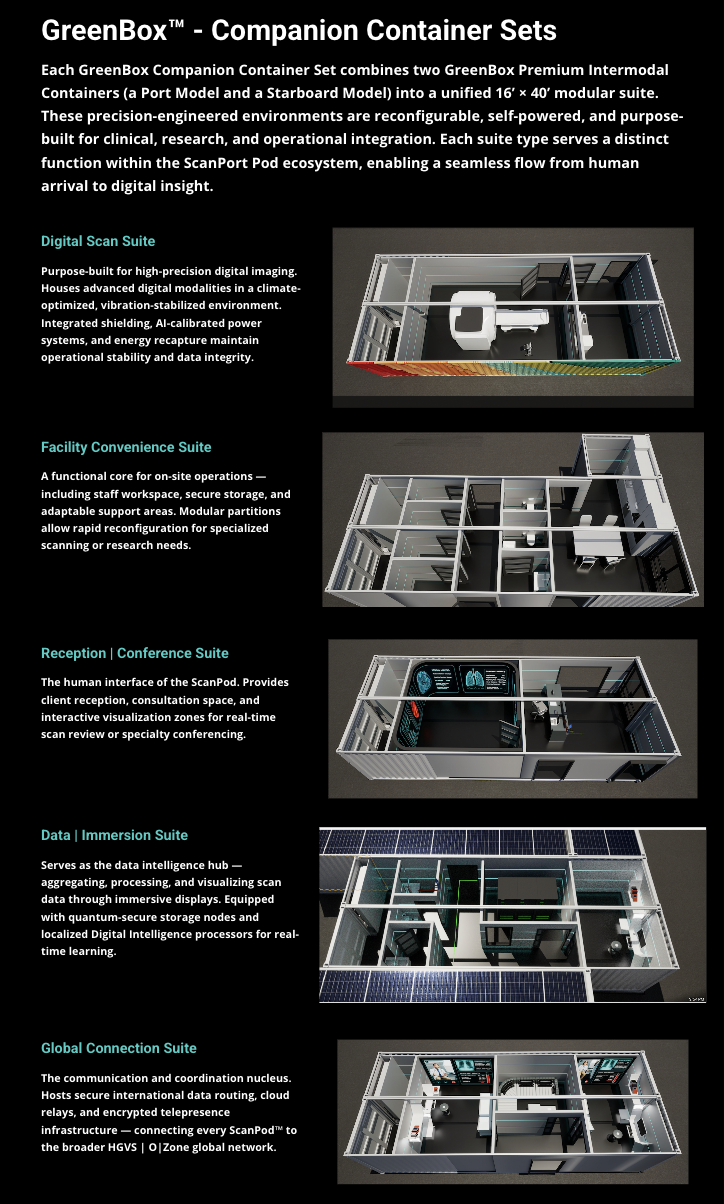
Press the GreenBox™ image above to explore Equipment Ownership, SDIC and the modular infrastructure framework.
Redirecting Capacity Into Productive Infrastructure
Many O|Zone™ Opportunities require substantial equipment and infrastructure. But no single Participant necessarily has to own or fund the whole.
Modular design enables qualifying equipment and infrastructure to be divided into identifiable Components which can be separately acquired and owned, then brought together through Project and Technical Stewards as part of a functioning Opportunity.
For some Participants, federal, state and local Government Incentives can create substantial Self-Directed Incentive Capacity—SDIC. Rather than simply satisfying tax liabilities, applicable Incentives may enable a Participant to redirect a portion of that capacity toward direct ownership of productive infrastructure.
Different Participants can bring different levels of capacity. Different Components can come together. And what no single Participant needs to create alone can become functioning infrastructure for a Community.
If you’re a high-income individual, have a Family Trust, or manage a Family Office, I’d particularly encourage you to take a closer look at what follows.
A new class of Section §48E Equipment Assets is emerging—productive equipment that can be individually owned and assembled over time into a diversified portfolio.
Available tax assets may offset as much as 70–85% of equipment cost, creating an opportunity to build a multi-year equipment portfolio as part of a longer-term tax and wealth strategy.
And there may be another interesting dimension. At disposition, these assets can potentially become part of a philanthropic strategy—creating additional tax benefits while enabling equipment portfolios to help fund nonprofit organizations over multiple years, providing an alternative to, and potentially amplifying, traditional cash donations. Keep reading below and I’ll introduce you to some of the pieces. Then, if you’d like to take a deeper dive, come back and press the GreenBox™ image above.
Opportunity Innovation Ecosystems are built around advanced equipment systems, modular facilities, and intelligent infrastructure supporting healthcare, communications, research, manufacturing, transportation, emergency services, and local digital transformation.
These next-generation facilities combine advanced AI computing with new forms of renewable energy generation, thermal energy recovery, energy storage, and technologies such as supercritical CO₂ power systems. They are designed to produce sufficient electricity to support their own digital infrastructure while creating resilient, community-scale operating environments.
Many of these integrated systems are intentionally engineered to qualify under the newer Section §48E Federal clean-energy framework, which encourages private ownership of qualifying energy infrastructure.
Self-Directed Incentive Capacity (SDIC™) is the ability to apply available federal, state, and local government incentives toward the acquisition and deployment of qualifying productive assets. Opportunity Innovation Ecosystems are designed to organize, coordinate, and apply this incentive capacity to accelerate the deployment of advanced equipment, modular facilities, digital infrastructure, AI-enabled systems, and other qualifying productive assets that support innovation, economic development, and community-serving initiatives.
Governments establish tax incentives because they want certain types of productive investment to occur. Rather than treating these incentives solely as tax benefits, Opportunity Innovation Ecosystems are designed to organize them as a form of Self-Directed Incentive Capacity that participants may apply toward the acquisition of productive infrastructure assets.
Rather than these incentives simply remaining dispersed across individual tax returns and isolated equipment purchases, Opportunity Innovation Ecosystems are designed to encourage participants to apply part or all of their Self-Directed Incentive Capacity toward creating a scalable resource for building shared productive community infrastructure.
Together, Initial Self-Directed Incentive Capacity and Disposition Self-Directed Incentive Capacity illustrate that qualifying productive assets may generate meaningful incentive capacity both at acquisition and again through a planned disposition strategy. Under the illustrative assumptions used in this model, Combined Self-Directed Incentive Capacity is presented as a measure of cumulative lifecycle incentive capacity and is not intended to represent investment return, cash flow, present value or other performance measures.
INITIAL ACQUISITION | DISPOSITION
From Incentive Capacity to Continuing Infrastructure
The potential benefit of acquiring qualifying advanced equipment may extend well beyond its initial purchase.
At acquisition, applicable Government Incentives may enable a Participant to redirect a substantial portion of funds otherwise required to satisfy personal tax liabilities toward ownership of qualifying equipment and infrastructure.
The extended O|Zone™ Equipment site linked below includes an illustrative $1 million equipment acquisition in which the Purchaser advances $100,000 of initial capital. Under the assumed Federal scenario,approximately $696,000 of Government Incentives are illustrated, leaving approximately $204,000 to be financed. Under the assumed Federal, State and Local scenario, approximately $856,000 of Government Incentives are illustrated, leaving approximately $44,000 to be financed.
In each illustration, $100,000 of Purchaser Capital, together with applicable Government Incentives and financing in the range of $44,000 to $204,000, supports the acquisition of $1 million of productive equipment.
Initial Productive Lifecycle | Then an Exit Strategy
Advanced medical, digital, energy and other equipment has a lifecycle. After an initial productive deployment—generally 7–8 years for the equipment contemplated in the illustration—it may retain substantial useful life and value, particularly when it can be refurbished, upgraded or reconfigured.
Disposition Self-Directed Incentive Capacity - recognizes that qualifying productive assets (particulary advanced technology assets) are intended to follow a planned lifecycle rather than remain indefinitely in the ownership of a single participant. Opportunity Innovation Ecosystems are designed to facilitate the orderly transition, refurbishment, replacement and redeployment of qualifying productive assets as successive generations of technology emerge.
At the end of that initial lifecycle, the initial Purchaser may elect to gift the equipment to a qualifying nonprofit organization, such as ScanKids™.
Subject to applicable requirements, the contribution may provide the Purchaser with an additional charitable contribution benefit. The detailed illustration on the linked O|Zone™ Equipment site follows this Exit Strategy as well. Under its assumptions, the Federal scenario illustrates approximately $190,000 of estimated remaining cash flow after repayment of acquisition debt, while the Federal, State and Local scenario illustrates approximately $638,000—in each case following the original $100,000 of Purchaser Capital.

Every community has families who are struggling with pediatric conditions and the long-term effects of Long COVID. ScanKids™ 501(c)(4) foundation—exists to give those families access to better resources and long-term support. And now, under current federal incentives, individuals can use their tax offsets to help build the energy and scanning infrastructure to support these programs for years to come. The entire site is designed to operate Beyond Net Zero, producing more clean power than it consumes—and directing that surplus to benefit children and youth through ScanKids™.
Opportunity Innovation Ecosystems are designed to facilitate the planned renewal of productive infrastructure.
A nonprofit organization is able to facilitate refurbishment and subsequent sale of the equipment, using the resulting proceeds to help support its continuing operations while the refurbished equipment begins another productive lifecycle with a new owner. As illustrated in the model, a refurbishment and resale in 8 years is estimated to produce $1.3 million for the non-profit organization, although no assurance can be given.
As qualifying productive assets complete one lifecycle and are replaced by successive generations of technology, participants may have the opportunity to redeploy capital into new qualifying productive assets, thereby creating a recurring framework for the continual renewal and expansion of their qualifying infrastructure assets portfolio as well as generating additional revenue for non-profits they support.
Self-Directed Incentive Capacity is generated through recurring annual tax obligations rather than a single year's transactions. Participants may have the opportunity to apply new Self-Directed Incentive Capacity year after year toward successive generations of productive infrastructure. Over time, this recurring process is designed to support the continual expansion of productive assets within Opportunity Innovation Ecosystems while contributing to long-term family, business, and community wealth creation.
Beyond ScanPort™ | Modular Infrastructure Across Opportunities
ScanPort™ provides one illustration of how modular infrastructure, specialized equipment and separately owned Components can be assembled into a functioning Opportunity.
The same architecture can extend well beyond healthcare.
Within O|Ma™, specialized equipment and modular infrastructure—including GreenBox™, JouleBox™ and GreenPad™ applications—can support agricultural production, controlled environments, processing, energy, water, storage and other AgriCommunity™ and AgriCampus™ activities.
Similar approaches can be applied across manufacturing, food production and processing, energy, digital infrastructure and a broad range of other productive uses.
The equipment changes.
The Participants change.
The Opportunity changes.
But the underlying idea remains the same:
productive Components can be separately acquired, financed, owned and brought together within modular infrastructure designed around the needs of the Opportunity.
What interests me most is that the capacity can renew. As new tax liabilities and applicable Incentives (SDIC) arise, a Participant may be able to do it again—redirecting additional Self-Directed Incentive Capacity into additional productive infrastructure throughout one's working life.
And as earlier equipment completes its initial lifecycle, the second lifecycle can begin—creating another potential benefit for the initial Purchaser, an ongoing benefit for a nonprofit organization, and an opportunity for equipment itself to be refurbished and returned to productive use.
Learn more about Participation Opportunities
Introducing the geographic operational infrastructure for State | Territory |DC Opportunity Innovation Ecosystems. The sections that follow describe the principal organizational and operational components that enable communities, institutions and other participants to organize, coordinate, implement and expand Opportunity Innovation activities through a common framework while preserving local priorities and governance.
Up to this point, we have been looking at ways Participants can help fund individual Opportunities, the Stewards that help them develop, and the productive infrastructure they may require.
Now widen the lens. Oklahoma’s Genesis implementation itself requires shared institutional, financial, insurance, digital and operating infrastructure. That creates another level of Opportunity. Some Participants may want to help build and capitalize that infrastructure—not for just one Opportunity, but to support many of them across the State.
Strengthening
Local Capital
Community banks can become an important part of the Genesis State Ecosystem—originating, servicing and participating in financing for local Opportunities.
The opportunity is not only to bring more activity to those banks, but also to help bring additional capital into the banks themselves—expanding their capacity to serve their Communities.
What interests me here is the opportunity to bring Oklahoma’s Community Banks directly into the Genesis State Ecosystem. They already know their Communities, their businesses and the people creating Opportunities around them. By connecting those banks into the broader framework, we may be able to help enhance their risk-based capital, bring additional capital into the banks themselves, and expand long-term service income as they originate, service and participate in financing across the State.
In other words, the opportunity is to build greater capacity within Oklahoma’s Community Banks—strengthening the institutions themselves while expanding the financial capacity available to the Communities they already serve.
Building Private | Public Capacity
Government Authorities and Port Authority Opportunity Zones provide a framework through which Communities, counties and private Participants can come together around shared infrastructure and Opportunities.
Private | Public Partnerships can combine private capital, experience and operating resources with governmental capabilities—creating additional ways to develop infrastructure and Opportunities that no single Participant needs to undertake alone.
Our design goal here is an opportunity for Local Governments to become real economic Participants in the Genesis State Ecosystem.
Private | Public Partnerships can bring private capital and capabilities alongside governmental authorities, while credit enhancement and digital transformation can expand what a County is able to undertake.
Digital Tariffs add another dimension. A portion of the revenue they generate can flow back into participating Counties—creating additional capacity to address local priorities, including legacy environmental conditions, Community health and the needs of at-risk Humans and populations.
And I think we can go further. Much of the value created every day by nonprofits and volunteers never appears in conventional measures of economic activity. If we can begin recognizing that contribution alongside the economic activity occurring within a County, Oklahoma has an opportunity to pioneer a much broader picture of Community productivity and value—one that other Communities across the country may ultimately choose to follow.
Connecting Networks + Portfolios
Alliance iii.oprovides a global digital network infrastructure built around several enduring first principles: unique identity, personal privacy, safe and secure global connection, and the principle that each Participant’s data remains that Participant’s data.
Agile Portfolio Platforms provide organizational and transactional frameworks through which Participants, assets, risks, intellectual property and activities can be securely organized and connected. Developed over more than four decades, APP structures can also provide bridges between established organizations engaged in traditional international commerce and emerging digital organizations—bringing both into secure transactional environments designed around high standards of integrity, safety and protection.
As I look at these two pieces together, there is something rather personal for me here. For more than four decades, much of my work has involved finding ways for people, institutions and transactions to connect across organizational, financial and international boundaries—while protecting the people, assets, information and relationships involved. What has changed dramatically is the technology. The underlying need has not.
Alliance iii.o gives us a global digital infrastructure built around identity, privacy, secure connection and a very simple first principle: my data is my data—and your data is yours.
Agile Portfolio Platforms give us organizational and transactional frameworks through which traditional institutions and emerging digital organizations can safely connect and do things together.
For me, its what makes this particularly interesting. We are able to bring more than four decades of experience with international organizations, transactions and relationships into a digital environment designed for what comes next.
Press InfoPort image to access IAC Cube™ information.

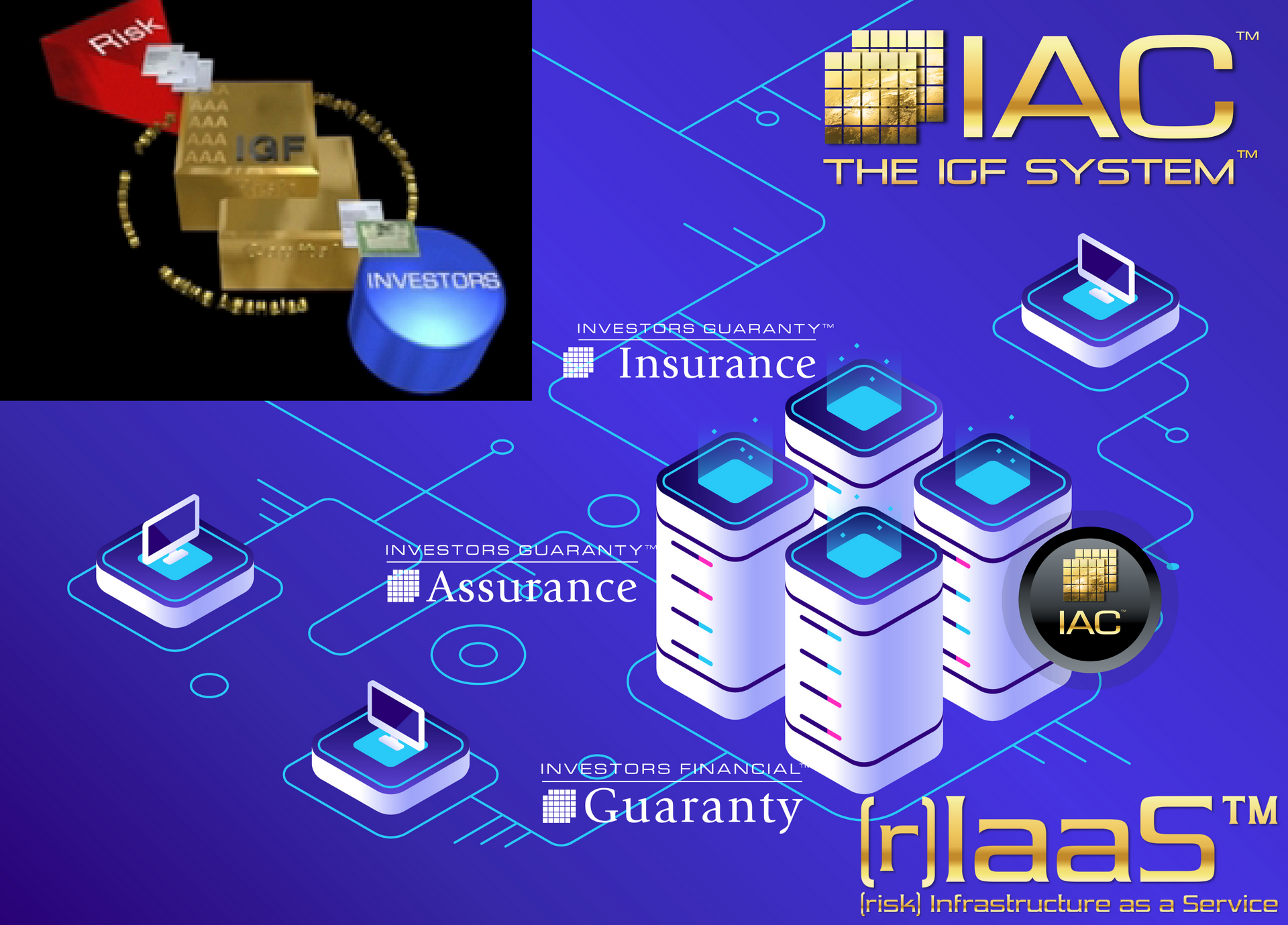
Each sponsored IAC™ Cube is comprised of assurance, insurance and financial guaranty IAC™ Insurers as well as an IAC™ administration system providing secure interconnect gateways to a variety of component Digital Infrastructure Utilities ("DIU"), Digital Unit Organisations ("DUO"), and nodes supporting various Decentralised Autonomous Organisation ("DAO") networks.
Each IAC™ Cube may connect internationally through DAOs and within the Bermuda Risk Platform designed for multi-facility redundant nodes operating within Bermuda.
Connecting Oklahoma to International Risk + Credit Capacity
The IAC™ infrastructure can support risks and transactions benefiting Oklahoma while the IAC™ insurers themselves conduct their insurance activities within Bermuda. Through appropriate brokers, intermediaries, underwriting advisors and other professional Participants, Oklahoma organizations, Community Banks, Government Authorities and other parties can connect with bespoke insurance, assurance, financial guaranty and international reinsurance capacity.
Qualifying letters of credit originated by participating Community Banks may be enhanced to the highest credit-quality level, supporting domestic and international transactions while preserving the local banking relationship. Qualifying tax-exempt municipal obligations issued through participating Government Authorities may similarly benefit from secondary-market bond insurance and credit enhancement.
The architecture also creates Opportunities for Oklahoma-based professional Participants and others to connect with and participate in the international IAC™ marketplace. Some Participants may see an additional Opportunity in facilitating sponsorship of an IAC™ Cube and expansion of the IAC Marketplace™.
As these pieces begin to come together, so does the framework—and that’s where this gets really interesting. Because within that framework, we can begin introducing technologies that create new ways for capital, risk and contractual relationships to be structured, connected and put to work.
Press InfoPort image to access FlexTec™ resources.
Risk Funding Infrastructure – Introduces institutional frameworks that strengthen funding, risk mitigation, custody, liquidity and financial capacity within Opportunity Innovation Ecosystems. These components help communities, institutions and enterprises support sustainable growth while managing financial, operational and institutional risks.
FlexTec™ is a family of financial, risk and transactional technologies designed to operate within institutional infrastructures such as those being assembled through Launch [OK].
Developed over several decades by Principals of AD&C, FlexTec™ technologies provide configurable frameworks through which capital, risk, contractual obligations and different Participants can be brought together around particular purposes and Opportunities.
Individual FlexTec™ technologies may employ contractual instruments, special-purpose entities, insurance and risk-transfer structures, financial guarantees, securitization, portfolio structures and other Components. Their purpose is not simply to provide funding, but to transform how capital and risk can be structured, connected and put to work within an operating ecosystem.
Press InfoPort image to access FlexGIA™ information.
FlexGIA™ transforms high-credit-quality institutional assets into a coordinated platform for investment stewardship, enterprise resilience and community opportunity.
FlexGIA™ rethinks the role of institutional fixed-income investments. Rather than serving only as investment assets (a high-quality short duration medium term note), FlexGIA™ Reference Series are designed to support investment stewardship, enterprise resilience, infrastructure funding and long-term economic development through a coordinated institutional framework.
The Genesis implementation begins with an initial O|Zone™ Opportunity Innovation Series of FlexGIA™, designed to establish the first layer of long-term institutional capacity for the ecosystem.
If you’re involved with one of the institutional groups shown in LAUNCH [OK] Participation below, I’d particularly encourage you to spend a some time in the description and the information available through the InfoPort link above.
We’re bringing together institutional Participants for the initial O|Zone™ Opportunity Innovation Series of FlexGIA™ as part of launching Launch [OK].
Different institutions may participate for very different reasons—from investment and portfolio objectives, risk mitigation and financial services to healthcare, research, Community development and other institutional priorities.
At the same time, their participation can help establish the Oklahoma IAC Cube™ and the risk-mediation and innovation-funding capabilities that can support Opportunities across the state.
Our initial areas of focus include ScanPort™ and its individual and group diagnostic initiatives, together with agricultural Opportunities being developed through O|Ma™, AgriCommunity™ and AgriCampus™.
Funded through issuance of


FlexGIA™ Perspectives
Since 1999, FlexGIA™ have been viewed by life insurers and other affiliated financial institutions as high-quality, medium-term notes structured pursuant to Rule 144A and Regulation S as debt obligations, with a duration of less than one year.
O|Zone™ Opportunity Innovation Series FlexGIA™ are intended to be issued by a de novo IAC™ Insurer - Assurance formed under private legislation granted Royal Assent by Her Majesty Queen Elizabeth II. The Issuer is intended to form part of the IAC Cube™ infrastructure, comprising three specialized insurers established to provide risk transfer, funding, and financial guarantee capabilities in support of the LAUNCH [OK] initiative.
Payment of annually reset interest and repayment of principal on FlexGIA™ and payment of other Policy Payment Liabilities of the Insurer are fully supported by U.S. Treasury|Agency and other qualified obligations to assure the Insurer's ability to fully and timely pay 100% of all Insurer Policy Payment Liabilities. Since 1989, several U.S. rating agencies have assigned and/or indicated their willingness to assign special policy ratings to obligations of IAC™ Insurers within their highest rating categories applicable to USD soveriegn obligations.
Issuance Date - As determined at Issuance of a specific FlexGIA contract.
Maturity Date - Generally issued for a period of slightly more than 30 years.
Anniversary Date - Preferrably June 30 or September 30, applicable to annual interest crediting rate reset.
Prepayment Date - At discretion of the Issuer subject to notice provisions agreed with FlexGIA™ Holder, at issuance.
The following market rates are included solely for illustration purposes.
1 Year US Treasury Rate Index - [3.97%], determined by current 1 Year US Treasury market rates at issuance
Initial Interest Crediting Rate - [XX.XX%], determined by current 1 Year US Treasury market rates at issuance
Lifetime Interest Rate Cap - [8.97%] Cannot exceed 500 basis points over 1 Year US Treasury Rate at issuance-Negotiated between Issuer and Holder
Annual Interest Rate Cap - Based on a market credit spread negotiated between Issuer and Holder at issuance. For example a 1 year BBB+ debt obligation interest rate [5.04%] may be assumed, as a basis point adjustment of [107 basis point] or a credit|liquidity spread of [26.95%.] Cannot exceed Lifetime Interest Rate Cap.
Lifetime Interest Rate Floor - [2.75%] Payment of Interest calculated at this rate daily is accrued for payment on Maturity Date or earlier Prepayment Date. Negotiated between Issuer and Holder. - Observation: Federal Reserve Inflation Rate Target has recently focused on 2.00% +/-
The interest crediting rate for the Reference Series for the period from issuance through the first reset date is determined at issuance. Periodic reset dates and frequency are described in an applicable Supplement to an FlexGIA™ Information Memorandum. On each reset date, Issuer will reset interest crediting rate for the next period, within a market-indexed periodic cap and floor, which floats within the applicable fixed lifetime cap and floor. The lifetime cap and floor are established at issuance.
The method of establishing periodic cap and floor is described in the applicable Supplement. Consistent with the periodic rate reset process, all reference interest rates are expressed as annual percentage rates (“APRs”). Issuer is to engage one or more internationally recognised certification firms to confirm establishment of applicable market rates, periodic cap and floor and calculations related to establishment of periodic interest crediting rate and any applicable prepayment premium, within permitted interest rate reset parameters. Upon each periodic interest crediting rate setting, Issuer notifies FlexGIA™ Holders, government approved custodian(s) as applicable, applicable rating agencies and where applicable, regulators.
The Initial Interest Crediting Rate established at issuance applies from the Effective Date through the first Periodic Reset Date identified in the Terms Appendix.
Beginning on each Periodic Reset Date thereafter, the Interest Crediting Rate is re-established annually for the succeeding Interest Crediting Period in accordance with the FlexGIA™ contractual framework.
Rather than relying upon a single market index or formula, each annual reset follows a governed contractual process that establishes a market-sensitive interest crediting corridor. The corridor consists of a Periodic Interest Rate Floor and Periodic Interest Rate Cap, both determined pursuant to the procedures established in the Reserve Resolutions and subject at all times to the Lifetime Floor and Lifetime Cap agreed at issuance.
The annual interest crediting corridor is established using the market benchmarks and contractual reference points identified in the Terms Appendix and governed by the Reserve Resolutions. These include applicable U.S. Treasury benchmarks, Treasury benchmarks appropriate to the remaining maturity of the FlexGIA™, the issuer’s Interest Rate Setting Capacity, and other contractual provisions applicable to the annual review. Collectively, these elements establish the discretionary range within which management determines the annual Interest Crediting Rate.
The issuer’s Interest Rate Setting Capacity reflects a governed assessment of its ability to support annual interest crediting while maintaining the long-term financial integrity of the FlexGIA™ framework. This assessment incorporates factors such as surplus performance, liquidity, reserve strength and other contractual considerations established under the Reserve Resolutions.
Depending upon prevailing market conditions and the issuer’s demonstrated capacity, the annual Interest Crediting Corridor may be adjusted within the contractual framework, while always remaining subject to the applicable Periodic and Lifetime Cap and Floor provisions.
The detailed methodologies governing the annual reset process, including the establishment of the Periodic Interest Rate Floor, Periodic Interest Rate Cap and Interest Rate Setting Capacity, form part of the Reserve Resolutions incorporated by reference into the FlexGIA™ contractual documentation.
The Reference Series matures on the Maturity Date, but Issuer may in its sole
discretion prepay the Reference Series in whole or in part as agreed at issuance. The Reference Series' expected average life is 7-12 years, although no
assurance can be given that principal and interest on the Reference Series will be
paid prior to the Maturity Date. Changes in long-term interest rates, returns on
invested assets of Issuer and applicable insurance premium revenue less claims may
cause Issuer to accelerate or defer the time for prepayment or preclude Issuer from
making a prepayment.
The Issuer may prepay all or a portion of accrued interest on any Periodic Reset Date.
It may also prepay all or a portion of the principal balance of the FlexGIA™, along
with the accrued interest, upon notice to Holders of the Reference Series.
If all or a portion of the principal is repaid in advance of Maturity Date, Issuer may
be required to pay Holder a prepayment premium. If the cumulatively compounded
return of previous periodic interest crediting rates is less than applicable interest rate
indexes, Issuer may be required to pay a prepayment premium designed to increase
Holder’s return as if the interest crediting rate for each period had been established
at such interest rate index rates, as agreed at issuance.
The manner in which a FlexGIA™ Reference Series may be reflected in a holder’s financial statements will depend upon the holder’s own accounting policies, regulatory environment, investment objectives, expected holding period, and the applicable accounting framework.
For some holders whose intention is to retain a Reference Series until repayment, a held-to-maturity accounting treatment may be appropriate where permitted under the applicable accounting standards. Under such circumstances, the carrying amount may generally reflect principal together with accrued interest in accordance with the holder’s accounting policies and applicable accounting requirements.
While this approach may be entirely appropriate for many institutions, it may not reflect the objectives of all holders. Some institutions may wish to retain greater balance sheet flexibility or preserve the ability to realise liquidity should future circumstances warrant. For such holders, accounting classifications that contemplate future disposition, where appropriate under the applicable accounting framework, may provide a more suitable reflection of management’s intentions.
The FlexGIA framework has been designed with this broader range of institutional objectives in mind. Although no assurance can be given regarding future market conditions, accounting treatment, or valuation outcomes, the contractual architecture has been structured with the objective that a Reference Series may, under normal circumstances, maintain a high degree of principal integrity while simultaneously incorporating contractual characteristics that extend beyond those typically associated with conventional high-quality short-duration medium-term notes. Those additional contractual characteristics may, for some holders and under some circumstances, give rise to considerations extending beyond principal plus accrued interest. The recognition, measurement and reporting of any such value are matters for each holder to determine in consultation with its own management, accountants, actuaries, valuation professionals, auditors, regulators and financial advisers, having regard to its own circumstances and the applicable accounting and regulatory framework.
A FlexGIA™ held within an available-for-sale accounting framework may reasonably support a fair value that exceeds principal together with accrued interest as a result of its unique contractual rights and other economic characteristics.
Having considered the accounting framework applicable to a FlexGIA™, let us now consider those attributes of the Reference Series that may reasonably support its fair value when held as an available-for-sale debt obligation designed to maintain a stable value of principal together with accrued interest. Each attribute should be considered both individually and collectively in assessing the economic characteristics of the instrument.
Credit - Every payment of established interest, annually credited interest and repayment of principal is designed to be fully supported by United States Treasury | Agency obligations maintained in a secure custodial relationship under the applicable statutory framework, with the objective of assuring the Issuer’s ability to timely pay credited Interest and repay Principal.
Interest Crediting - The annual interest crediting mechanism is designed by reference to be annually reset to above the prevailing one-year United States Treasury index together with a contractual credit|liquidity spread agreed at issuance.
When considered as an available-for-sale debt obligation, the contractual architecture of a FlexGIA™ is designed to support a fair value at or above principal together with accrued interest through a combination of Treasury-supported payment obligations, annually resetting interest crediting, principal integrity and other contractual protections.
Having considered those contractual attributes designed to support a fair value at or above principal together with accrued interest, the next step is to consider whether certain additional contractual characteristics may reasonably support incremental fair value.
The FlexGIA™ framework incorporates a number of contractual attributes that create potential economic benefits for both the Holder and the Issuer. Some of these attributes may be capable of objective financial analysis and valuation. Others may provide strategic, regulatory or operational benefits that, while economically significant, may not readily lend themselves to direct measurement.
Accordingly, this section does not attempt to value every contractual attribute. Rather, it considers those attributes that knowledgeable holders may reasonably conclude have the potential to contribute to fair value in excess of principal together with accrued interest at the time of acquisition or during the holding period.
FlexGIA™ Holder Fair Value Perspectives
Contractual provisions incorporated into a FlexGIA™ include measurable financial, regulatory, operational, tax and/or strategic elements that knowledgeable Holders may reasonably conclude contribute incremental value beyond principal together with accrued interest. Accordingly, such contractual characteristics may appropriately be considered in a Holder’s assessment of fair value.
There are several things about FlexGIA™ I think are worth noting.
They increase surplus capacity within IAC Insurers for risk transfer, risk mitigation and risk retention.
Previous Insurance Company Holders have indicated these instruments were routinely booked at values in excess of principal plus accrued interest, noting the instruments’ unique design of annual interest crediting and its look-back make-whole prepayment feature.
In addition, their terms at issuance generally include an interest crediting rate methodology designed to establish interest annually in excess of a one-year U.S. Treasury Index, its comparable benchmark.
FlexGIA™ is an annually reset, short-duration debt obligation for institutional Holders.
Designed to enhance FlexGIA™ liquidity
Why an ETF? - The FlexETF™ structure separates the underlying investment assets (a diversified portfolio of US Treasury|Agency backed FlexGIA™ and immdeiately available USD funds) from ownership interests in FlexETF™ Units acquired by investors.
Rather than purchasing an individual FlexGIA™, which is only available to Institutional Purchasers, these $1,000 units become available to a much wider audience. FlexETF™ enable fractional ownership, exchange trading, portfolio diversification, and modern settlement mechanisms while preserving the contractual characteristics of the underlying portfolios of FlexGIA™.
Reference Series Diversification - Qualifying FlexGIA™ Reference Series within a FlexETF™ may have differing contractual and economic characteristics, including periodic interest-crediting caps and floors, interest-crediting rate spreads above the applicable one-year U.S. Treasury Index, and look-back make-whole prepayment characteristics.
Individual Reference Series may also differ in the timing of interest payments, with interest either paid to the FlexETF™ or accrued through maturity or earlier prepayment.
Prepayment activity may similarly vary among Reference Series. Changes in longer-term interest rates may result in increased prepayment activity across multiple Series, while other prepayments may arise from strategies or circumstances particular to individual issuing IAC™ Insurers.
Proceeds received by the FlexETF™ from interest or prepayment may be used to acquire additional qualifying FlexGIA™ Reference Series, repurchase outstanding FlexETF™ Units, or be held pending subsequent deployment.
Liquidity for Institutional FlexGIA™ Investors - FlexGIA™s were originally designed to be held by institutional parties to maturity or prepayment in increments no less than USD$25 million. As institutional ownership expands, however, some holders may desire a liquid, exchange-traded alternative.
The Qualifying FlexETF is designed as a mechanism through which FlexGIAs may be aggregated into exchange-traded investment vehicles, enabling investors to participate in a diversified portfolio of US Treasury|Agency backed individual units as small as USD$1,000, with daily accretion.
Settlement of Traded ETF Units - Exchange trading of ETF Units and settlement of ownership are distinct functions. While ETF Units may trade on various exchanges in the conventional manner, ownership records and settlement technologies continue to evolve. The qualifying FlexETF contemplates that ETF Units may, where permitted, be digitally recorded and settled using modern electronic ownership and control frameworks, including UCC Controllable Electronic Records (CERs).
Direct participation in a FlexGIA™ Reference Series is intended for institutional-scale investors, with minimum investment positions beginning at approximately $25 million. The Qualifying FlexETF™, however, transforms those institutional investment interests into standardized, publicly traded Units with an illustrative initial value of approximately $1,000 per Unit. This transformation significantly broadens participation by making institutional-quality Opportunity Innovation Ecosystem investments accessible through the public securities markets.
FlexETF™ Portfolio Strategies
Qualifying FlexGIA™ Reference Series may be aggregated into different FlexETF™ portfolios based upon the purpose and characteristics of the underlying Series.
O|Zone™ Opportunity Innovation Series FlexGIAs associated with individual State implementations may, for example, be aggregated into FlexETF™ portfolios designed around those State Opportunity Innovation Series. Other initiative-specific or specialized FlexGIA™ Reference Series may similarly be aggregated into corresponding initiative-specific or specialized FlexETF™ portfolios, allowing different families of FlexGIAs to be assembled around a defined investment focus or strategy.
FlexETF™ Units may also permit fractional ownership interests, enabling substantially smaller participation increments while preserving the institutional FlexGIA™ Reference Series within the underlying portfolio.
The Qualifying FlexETF™ framework is designed to transform institutional-scale contractual investment assets (FlexGIA™) into standardized, exchange-traded investment Units (FlexETF™) that can be more broadly owned, transferred, and settled while preserving the contractual characteristics of the underlying diversified portfolios.
There are two sides of this that I find particularly interesting.
For institutional Holders, FlexGIA™ provides an opportunity to acquire a short-duration institutional obligation and potentially later sell an interest in that FlexGIA™ to an applicable FlexETF™, perhaps realizing a gain in the process, although no assurance can be given.
Then look at what happens on the other side. Once qualifying FlexGIAs are brought together within a FlexETF™, interests that began as institutional-scale instruments may support substantially smaller exchange-traded Units available to eligible individual and other purchasers.
LAUNCH [OK] Participants
Opportunities Participants
FlexGIA Participants
ETF Participants
LAUNCH [LABS] Participants
Steward Participants
The Genesis implementation of LAUNCH [OK]™ is intended to establish the institutional infrastructure upon which Opportunity Innovation Ecosystems may be developed throughout Oklahoma. Rather than asking participating institutions, organizations and persons to support a single project, the framework is designed to create long-term capabilities that may benefit communities, governments, businesses, healthcare organizations, financial institutions, universities and other participants for decades to come.
Participating institutions may enter the framework for different reasons. Some may initially recognize the investment characteristics of FlexGIA™. Others may be interested in healthcare innovation, infrastructure funding, enterprise resilience, financial guarantees, community banking, advanced manufacturing, research, or other Opportunity Innovation initiatives. Together, these diverse institutional perspectives help establish a common framework capable of supporting many future opportunities.
Individuals may also choose to participate in the LAUNCH [OK] framework in different ways. Business leaders, entrepreneurs, high-income individuals, family offices, philanthropists and other participants may contribute experience, relationships, leadership, investment and other resources to help establish and strengthen Opportunity Innovation Ecosystems. As the framework develops, participants may also have opportunities to allocate applicable federal, state and local incentive programs in support of qualified initiatives, helping align private participation with long-term community development objectives.
What you’ve just explored reflects many years of thinking, designing, developing and, in many cases, putting these ideas to work. If somewhere along the way you saw something that interests you—an Opportunity, an idea, a place where your experience or capabilities might fit—I hope you’ll explore it further. And if you would like to participate in any way, we would be honored to have you involved.
Thank you for taking the time to make this journey with us.